

Three numbers arrived in the same week and they do not line up cleanly. Housing is sliding into a freeze, with pending sales at a record low and mortgage rates near 7.6%, just as the Fed considers further hikes. At the same time the broader economy is on track for 3% growth in the third quarter and a strong start to the fourth, powered by an AI investment boom that is lifting productivity and profits. The catch is that most households still see prices about 30% higher than before the pandemic, and businesses are now trying to pass supply-cost increases through to customers. While growth is real, affordability and inflation are the constraints.
Subscribe for free to receive our FREE Retirement Calculator and Guide
Housing is sliding into a freeze just as the Fed weighs more rate hikes, and the cost of a mortgage is the problem
The housing market did not merely cool in September. It stalled. Pending sales, the deals that are signed but not yet closed, fell to an all-time low in records that go back to 2001. Starts dropped more than expected, single-family permits sank to their lowest level since 2023, and the 30-year mortgage finished the month near 7.6%, more than double the roughly 3% rate that fueled the last boom. Builder sentiment is now at lows not seen in 14 years. Chris Rupkey of Fwdbonds captured the moment when he wrote that the market is about to go into a deep sleep unless the cost of a new home becomes more affordable. “It is not winter yet,” he added, “but housing is going into a deep freeze.”
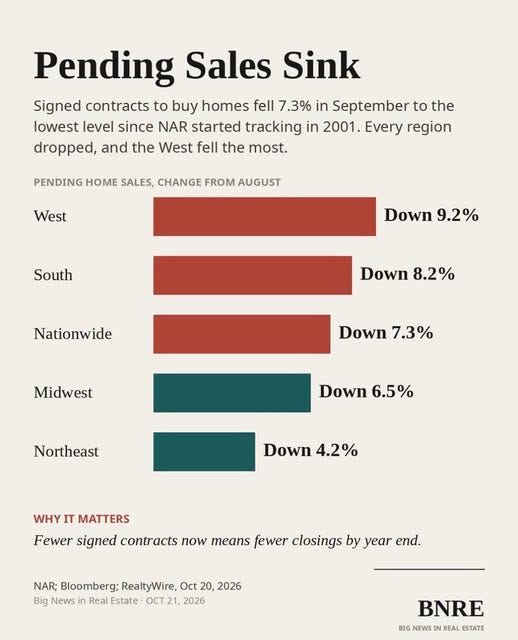
What makes the freeze harder to break is that the Fed is not in a position to cut rates because of how high inflation is. Wholesale goods prices rose at the fastest pace in a series that goes back to 2009, and officials are also watching the inflationary effects of heavy spending on artificial intelligence, which is pushing up the cost of chips and electronics. At the same time, the vast majority of existing homeowners are locked into rates well below today’s level. That makes it expensive for them to sell and buy something else, so the usual churn of the market has slowed to a crawl. Lawrence Yun of the National Association of Realtors noted that job growth and income gains can still support purchases, but affordability is more sensitive to mortgage rates than almost anything else.
Goldman Sachs expects the squeeze to weigh further on activity in 2027. The firm sees residential investment declining over the next three quarters and projects both new construction and existing sales staying well below pre-Covid levels. Markets expect the Fed to hold rates steady next week, but futures imply a strong chance of a quarter-point hike in December and another in March 2027. Yun sees one possible offset: because mortgage rates have already risen more than the Fed’s short-term moves, they could be topping out. The so-what is that higher borrowing costs are freezing both new construction and existing-home turnover before the Fed even decides, and another hike would tighten the lock-in further.
Subscribe for free to receive our FREE Retirement Calculator and Guide
The economy is growing faster than expected on an AI investment boom, but most Americans still feel left out
The U.S. economy is on track to grow 3% or more in the third quarter and could post annual growth of 2.5% in 2026, shrugging off high oil prices, lingering tariffs, the conflict with Iran, and the end of tax-refund spending and the World Cup summer boost. Just a few years ago the fastest sustainable pace was thought to be around 1.8%. Many economists now see 2% to 2.5% growth through the rest of the decade, driven by a once-in-a-generation investment boom—first in software and other technologies during labor shortages, then in artificial intelligence. Productivity rose at a 2.4% annual rate from 2022 to 2025, versus 1.4% in the five years before the pandemic, and profit margins for S&P 500 companies reached almost 16% this year, compared with 8% to 12% from 2010 to 2019. Eugenio Aleman of Raymond James called the AI revolution real and “not your father’s housing bubble.”
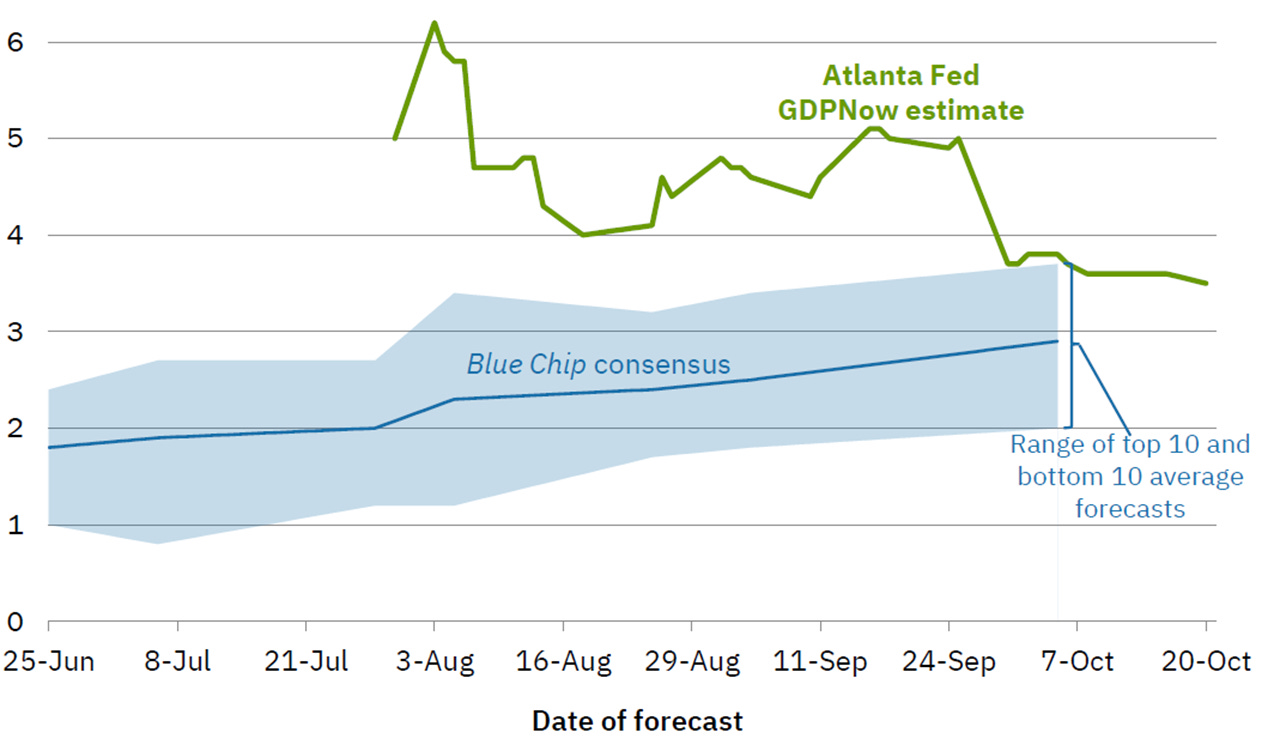
The U.S. economy is growing steadily into the last few months of 2026, setting up a great runway for the economy to take off in 2027 (Source: Atlanta Federal Reserve)
Most Americans are not feeling the gains. Goods and services cost about 30% more than before the pandemic, and wages are rising a little over 3% a year—not enough to keep up with inflation. Jim Baird of Plante Moran Financial Advisors said if most people ask whether they are better off than four years ago, the answer is not really. Strong GDP still means most jobs are safe. Layoffs are near historic lows and unemployment is unusually low. That level of job security has supported consumer spending, which accounts for two-thirds of growth and has risen 2.6% a quarter since 2022. But the spending is concentrated. A Moody’s Analytics study found the richest 10% of Americans accounted for a record 50% of all consumer spending. The stock market’s AI-driven gains have powered a wealth effect that lets older and higher-income households spend freely.
The longer-term catch is a slower-growing labor force. From 1950 to 2025 the potential labor force rose about 1.4% a year. The Congressional Budget Office expects just 0.4% or less through 2030, and it could shrink if more baby boomers retire and immigration stays frozen. That makes productivity the only reliable source of growth and bigger wage gains. Michael Pearce of Oxford Economics noted that if AI productivity gains disappoint, the economy could slow more sharply. Aleman put the gap plainly: the economy is growing, but it is not translating into higher income growth and employment. Headline growth and stock gains are real, but they are not yet showing up in most paychecks.
Subscribe for free to receive our FREE Retirement Calculator and Guide
The economy is booming into the fourth quarter, but companies are passing higher costs to customers
The U.S. economy is still running strong on the verge of the holiday shopping season. A pair of S&P surveys showed businesses hiring more workers to keep up with rising customer demand, and Chris Williamson of S&P Global Market Intelligence said the economy continues to boom at the start of the fourth quarter, though cost pressures remain a key concern. Companies saw increased demand from U.S. households and businesses, plus a pickup in export orders. Steady consumer spending and massive investment in artificial intelligence were among the key drivers. A survey of top executives pointed to the best growth spell for U.S. businesses since early 2015, excluding the COVID-19 pandemic, and employment increased in October at the second-fastest pace in four years. For now, businesses are not anticipating a slowdown in demand.
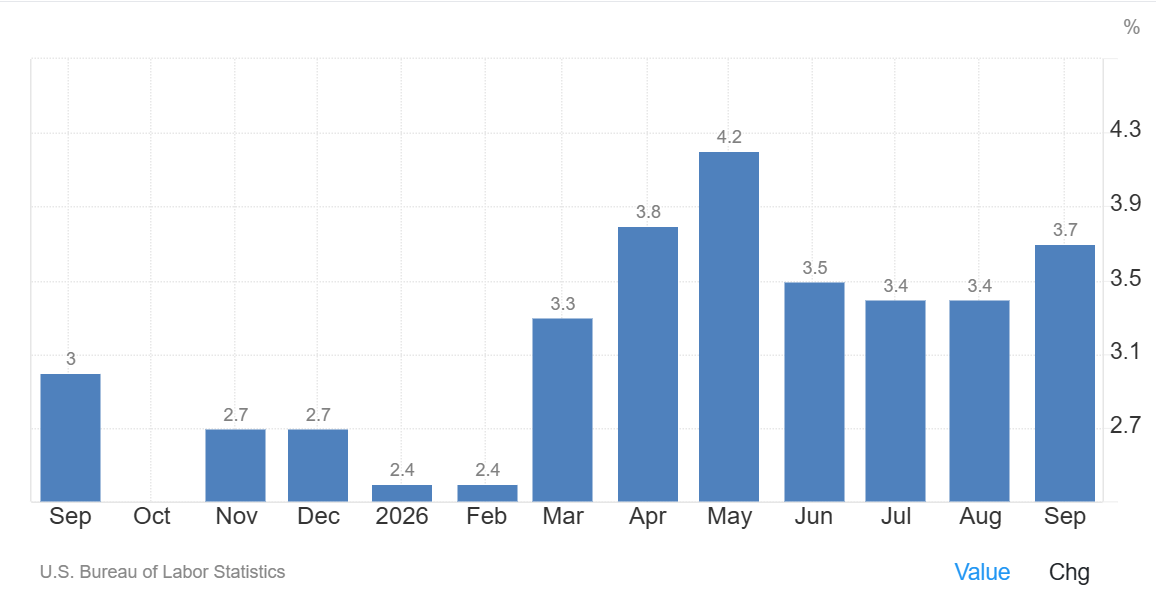
GDP is growing at a rapid pace despite the Iran War, with GDP growth reaching 3.7% in September (Source: U.S. Bureau of Labor Statistics)
The problem is prices. All that demand is pressuring the cost of business supplies. Critical shortages of some raw materials—tied to the ongoing conflict with Iran—and high oil prices are major sources of inflation. Businesses are trying to pass those higher costs on to customers, and they have more leverage because demand has risen. Williamson said that if that keeps up, consumer-price inflation is likely to rise further above the Fed’s target in the coming months. Inflation has already risen over 3.5% in the past year, well above the Fed’s 2% target. The Fed raised a key interest rate in September to contain inflation and is expected to increase borrowing costs in the months ahead. Higher rates might cool inflation, but they could also slow the economy.
The so-what is that strong growth and hiring are still in place heading into the holidays, powered by consumer spending and AI investment, but the same demand is giving companies room to raise prices. Raw-material shortages and high oil prices are feeding the pressure. The Fed’s expected rate increases are meant to cool inflation, yet they risk slowing an expansion that businesses currently see as durable. For households, the boom is real, but the cost of living is still the open question.
Subscribe for free to receive our FREE Retirement Calculator and Guide
Follow along on social media for key updates:
Instagram: TheMarketDispatch
Disclaimer:
The information provided by The Market Dispatch is for educational and informational purposes only and should not be construed as financial, legal, or investment advice.
The Market Dispatch, its authors, and contributors are not financial advisors, brokers, or attorneys. Any opinions, analyses, or projections expressed are solely those of the authors and do not constitute specific recommendations for any individual.
Investing involves risk, including the potential loss of principal and capital. Past performance does not guarantee future results. Before making any financial decisions or investments, you should consult with a qualified financial advisor or other professional who understands your personal circumstances.
By reading this newsletter or using any related materials, you acknowledge and agree that The Market Dispatch and its team will not be held liable for any loss, damage, or expense incurred as a result of reliance on the information provided.
Raising rates isn't going to stop this type of inflation. It just hurts people trying to get ahead with home purchases, college, vehicles and business growth.