

Three stories that look unrelated all point at the same pressure. Europe is testing whether it can still rescue a large sovereign when the politics have not changed. The Middle East just suffered an attack against a pilot and two others at a major Gulf airport, yet oil fell once Washington postponed strikes on Iran past the midterms. And in the U.S., a 10-year Treasury at 5.35% has quietly made cash and bonds competitive with stocks for the first time in more than a decade. Fiscal limits, regional disruption, and the return of yield are now shaping the same set of household and market decisions.
Subscribe for free to receive our FREE Retirement Calculator and Guide
France may have become too big for the ECB to bail out, and the debt math is getting worse
France is on a fiscally unsustainable path and may have crossed from too big to fail to too big to save, according to Nobel economist Paul Krugman. The country is running large budget deficits that keep pushing up an already high debt-to-GDP ratio, while interest costs on the existing debt pile continue to mount. A core problem, Krugman argues, is the failure to raise a relatively low retirement age as the population ages. Because France uses the euro, it cannot print its own currency if investors lose confidence. The risk is the same sequence that played out in Greece, Portugal, Spain, and Italy from 2009 to 2012: investors stop buying the bonds, the government faces the prospect of default because it lacks the cash to pay interest and principal, fear of default triggers more capital flight, rates rise further, and the spiral deepens. Prime Minister Sébastien Lecornu is trying to pass a contentious 2027 budget that would impose tens of billions of dollars in fiscal consolidation, while student protests over education underfunding continue.
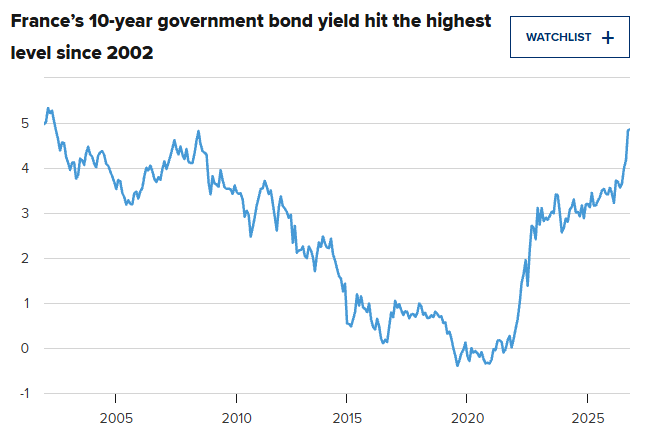
France is facing higher and higher borrowing costs as their bond yields spike (Chart source: CNBC)
Krugman notes that the ECB’s 2012 promise under Mario Draghi to do “whatever it takes” worked in large part because southern European countries made massive spending cuts. A French bailout would be extremely expensive and politically contentious as long as the country keeps moving further from fiscal responsibility. It is all too easy, he writes, to describe an ugly scenario that would be extremely divisive within Europe. Former ECB President Jean-Claude Trichet told CNBC that the ball is with the French government and parliament, and they have hard work to do. Destabilization tools exist and proved effective in the past, including the European Stability Mechanism and, at the extreme end, the ECB’s Transmission Protection Instrument, an unused 2022 measure meant to prevent market fragmentation in the euro area. Activating it would require France to ask for help, which the government currently says is not needed, and would also require a credible plan.
Trichet’s point is that France has to help itself first. During the sovereign debt crisis, outside support only worked if a country could convince markets, investors, and savers that it was moving in a credible direction. He urged politicians of all stripes, with a presidential election approaching and the political situation complex, to prove they can deliver something credible. Without that, the instruments stay on the shelf, and the risk of a self-reinforcing loss of confidence remains. For the rest of Europe, the second-largest economy in the EU is testing whether the euro area can still manage a big sovereign problem the old way, and the answer is no longer obvious.
Subscribe for free to receive our FREE Retirement Calculator and Guide
Houthi strikes kill three at Riyadh’s airport, and oil is still pricing a longer disruption.
Three Saudi nationals, including a pilot, were killed Thursday in two attacks on King Khalid International Airport in Riyadh by Iran-backed Houthi militants, Saudi aviation authorities said. The first strike targeted airport facilities; the second hit a Saudia aircraft. Captain Hamoud Ali Alkalthami was among those killed. The Houthis claimed the attacks. The Saudi-led coalition said it had destroyed three Houthi missile launchers and vowed a firm response, with Major General Turki al-Malki stating that attacks on civilians and civilian infrastructure would be met firmly. Hundreds of flights out of Saudi Arabia were canceled Thursday, according to Cirium data. By Thursday evening, 31 flights scheduled for the next day had already been canceled. Saudi authorities said Friday that airport operations and air traffic had returned to normal.

Flames rise from Riyadh airport after Houthi strikes (Source: The Guardian)
The strikes are the latest escalation. Smoke was seen near Riyadh’s main airport last month after the Houthis claimed to have targeted sensitive sites in the city. Saudi Arabia backs Yemen’s internationally recognized government in a civil war that has reignited in recent weeks amid the U.S.-Iran war. On Monday, Turkey and Pakistan agreed to help Saudi Arabia implement deterrence measures and deploy forces to support Yemeni counterattacks on the Houthis, after Yemeni forces reclaimed a key Red Sea port city. Reuters reported Thursday that France and Saudi Arabia were exploring ways for the French military to help protect the Yanbu oil terminal on Saudi Arabia’s Red Sea coast.
For energy markets, the immediate signal was mixed. President Trump said Thursday the U.S. would not launch attacks on Iran until after the November 3 midterm elections, and that Washington was having productive discussions with Tehran. Iranian Foreign Minister Abbas Araghchi said Tehran was reviewing a U.S. proposal and would respond in the next few days. Both sides acknowledging talks took some pressure off oil into the close, Deutsche Bank’s Jim Reid noted. Even so, negative headlines won out, and investors were pricing a longer period of disruption into next year. Oil futures fell after Trump’s comments and extended the decline into Friday morning. Front-month Brent was last seen 1.3% lower at $102.94 a barrel. West Texas Intermediate was last seen 1% lower at $90.51. The so-what is that a deadly strike on a major Gulf airport did not push oil higher once the prospect of delayed U.S. action and ongoing talks appeared, but the market is still treating the regional disruption as something that lasts past the election.
Subscribe for free to receive our FREE Retirement Calculator and Guide
High Treasury yields just ended the “no alternative to stocks” era, and cash and bonds finally pay again.
The idea that stocks were the only real way to earn a decent return has been the default mood for more than a decade. That shorthand, TINA for “there is no alternative,” took hold after the 2007-2009 bear market when near-zero rates made government bonds unattractive. Eileen Olson, a certified financial planner and founder of Emerald Wealth in South Carolina, puts it plainly: TINA was never an investment strategy. It was a mood. Near-zero rates pushed people into stocks because nothing else paid. That setup has changed. The S&P 500 hit an all-time high on October 6, but Treasury yields are now at levels not seen in decades. On Wednesday the 1-year Treasury bill yielded 4.442% and the 10-year note yielded 5.35%, the highest since April 2002. Olson says many investors have not adjusted because the last 15 years trained them to treat stocks as the only game in town. That is recency bias, and she calls it one of the most expensive habits in investing.
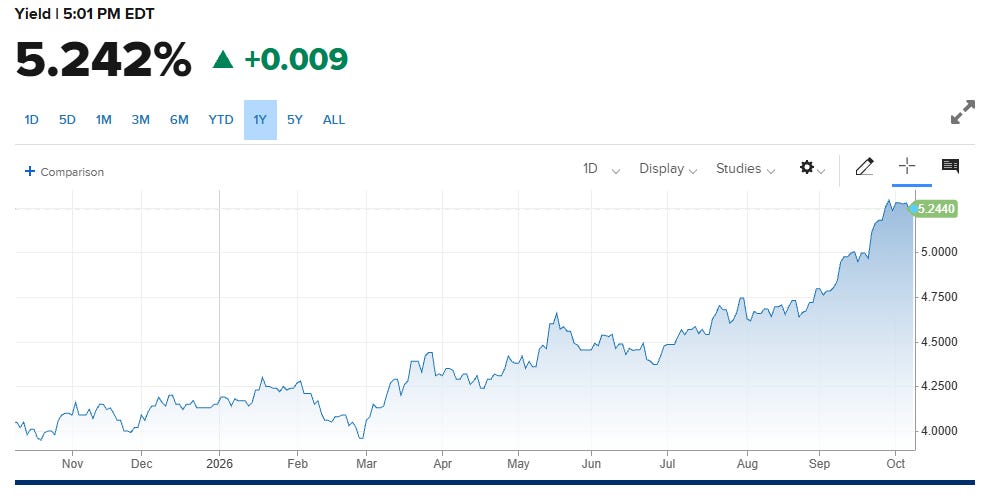
The yield on the 10-Year bonds has been increasing in the past year, making it more attractive for investors (Chart source: CNBC)
Bonds have historically delivered lower average returns than stocks over long periods. They also come with lower volatility and stable, practically guaranteed income if held to maturity. With even the lowest-risk bonds now paying a rate that is competitive with short-term stock returns, the question is whether they belong in a given portfolio. The right starting point is not stocks or bonds. It is what the money is for. Money needed for a house in two years, retirement income in five, and grandchildren in twenty should not all be invested the same way. For goals 10 years or longer, stocks still make sense. The S&P 500 delivered positive returns in over 98% of 10-year periods from 1937 through 2025, according to Hartford Funds. Annual returns have averaged around 10% since 1957, per Fidelity, and the average 10-year return was nearly 15% from 2016 through the end of 2025. Joseph Boughan, a Massachusetts CFP and owner of Parkmount Financial Partners, notes that the probability of a negative return rises each year the horizon is shorter than 10.
For an intermediate goal five years out, a Treasury note matched to that timeline removes default risk. The more than 5% a year currently available on a 5-year Treasury is all but guaranteed if held to maturity. That matters for a down payment. A double-digit stock decline can erase part of it. For money needed soon, high-yield savings accounts now offer annual percentage yields north of 4.25%, according to Bankrate. Olson’s practical point is that investors can finally be paid well to hold the cash they will need soon, and let stocks do the long-term work without having to sell them in a downturn to pay the bills. Temporary conditions should not drive changes to a long-term plan. Cash and government bonds are no longer a consolation prize. For the first time in years they are a real alternative, and the cost of treating every dollar as long-term equity has gone up.
Subscribe for free to receive our FREE Retirement Calculator and Guide
Follow along on social media for key updates:
Instagram: TheMarketDispatch
Disclaimer:
The information provided by The Market Dispatch is for educational and informational purposes only and should not be construed as financial, legal, or investment advice.
The Market Dispatch, its authors, and contributors are not financial advisors, brokers, or attorneys. Any opinions, analyses, or projections expressed are solely those of the authors and do not constitute specific recommendations for any individual.
Investing involves risk, including the potential loss of principal and capital. Past performance does not guarantee future results. Before making any financial decisions or investments, you should consult with a qualified financial advisor or other professional who understands your personal circumstances.
By reading this newsletter or using any related materials, you acknowledge and agree that The Market Dispatch and its team will not be held liable for any loss, damage, or expense incurred as a result of reliance on the information provided.
According to a Bloomberg analysis, about 38 percent of high-grade French corporate bonds now yield less than French government bonds of similar maturity.
https://www.bloomberg.com/news/articles/2026-10-08/france-s-debt-is-now-riskier-than-38-of-nation-s-company-bonds