

While domestic budgets are running on fumes, the U.S. financial war machine is delivering massive blows abroad, utilizing "Operation Economic Fury" to outright seize $1 billion in Iranian cryptocurrency and push the blockading regime to the absolute end of its financial tether. Yet, even as the Trump administration inches closer to a final determination on the conflict, a permanent scar has been left on the global supply chain. This week, we break down why your paycheck is losing the race against basic expenses, how the Treasury is choking off illicit oil revenues, and why shipping experts warn the Strait of Hormuz will remain permanently altered long after a peace deal is signed.
Subscribe for free to receive our FREE Retirement Calculator and Guide
The Invisible Squeeze: Savings Hit Lowest Level Since 2022 as Expenses Outpace Pay
The buffer between Americans and financial precarity is shrinking at an alarming rate. The personal savings rate plummeted to a meager 2.6% in April, a sharp decline from March’s 3.2% and less than half of the 5.8% rate seen just one year ago. Outside of a brief period of aggressive post-pandemic spending in 2022, a savings rate this low has almost never been recorded in the past 65 years. The reality hitting home is simple: even with recent tax cuts, the money coming in is officially losing the race against sticky inflation.

People are feeling the effects of the cost of everything going up, especially when it comes to gas and energy prices.
This dramatic drop in savings is being driven by the skyrocketing cost of daily basics. Overall inflation rose 3.8% in April from a year earlier—hitting its highest level since May 2023—while average hourly earnings lagged behind at 3.6% growth. Household budgets are being slammed by rising costs for utilities, healthcare, and groceries, alongside a massive pain point at the pump, where the national average for gasoline has reached $4.43 a gallon. Because families cannot easily opt out of paying for electricity or food, the extra cash that used to go into rainy-day funds is being entirely swallowed up by the cost of just getting by.
For the broader economy and your personal finances, this trend is a flashing warning sign that households are increasingly relying on financial lifelines. A staggering 37% of Americans—including more than a third of households earning over $100,000 a year—report that they will have to rely on credit cards, Buy Now Pay Later loans, or other debt just to cover basic expenses this month. Worse yet, workers are beginning to raid their future security to survive the present; outstanding 401(k) retirement loans climbed to 19.2% in the first quarter, alongside a visible spike in new hardship withdrawals. While many consumers still have enough cash to scrape by for the moment, economists warn a major period of belt-tightening is looming once temporary cushions like tax refunds dry up.
Subscribe for free to receive our FREE Retirement Calculator and Guide
Wallet Grab: U.S. Seizes $1 Billion in Iranian Crypto as Economic Blockade Tightens
The financial chokehold on Tehran has reached a dramatic new peak, with the U.S. successfully seizing roughly $1 billion in Iranian cryptocurrency assets. Treasury Secretary Scott Bessent revealed that under “Operation Economic Fury”—a massive financial pressure campaign launched in March 2025—U.S. authorities literally “just outright grabbed the wallets” of the Iranian regime. Combined with an ongoing naval blockade and targeted asset freezes, the Treasury department claims these aggressive tactics have cut off critical funding that regime leaders were siphoning to the tune of $400 million to $500 million every month.
The United States is using financial seizure as a way of pressuring the Iranian Regime into signing a peace deal to re-open the Strait of Hormuz
For the broader global economy, the data coming out of Iran suggests the regime is nearing a complete financial collapse. According to Bessent, Iran is currently dealing with a staggering inflation rate likely over 200%, forcing the government to hand out food vouchers, shut down the internet, and stop paying nearly half of its troops. Ironically, Iran’s own military aggression against its neighbors backfired and made the U.S. economic blockade much easier to enforce; after the Islamic Revolutionary Guard Corps (IRGC) launched missile attacks against all six Gulf states, those previously hesitant allies immediately opened up their banking books and helped the U.S. root out illicit, hidden Iranian oil revenues.
However, translating this financial victory into a final peace deal remains an incredibly complicated game for the Trump administration. Because top-tier leadership has been systematically dismantled by the conflict, U.S. negotiators are currently forced to deal with “third-level” officials. Bessent noted that talks are moving slowly because the U.S. has to simultaneously convince two heavily divided factions inside the remaining power structure: a strict clerical theocracy on one side, and a “thug autocracy” run by the IRGC on the other. President Trump held a White House meeting to make a “final determination” on the conflict, but until these fractured factions budge, the geopolitical risk hanging over global markets remains highly volatile.
Subscribe for free to receive our FREE Retirement Calculator and Guide
The Broken Chokepoint: Why a Peace Deal Won’t Fix the Strait of Hormuz
Even if the U.S. and Iran successfully iron out a peace agreement, the global energy market is staring down a permanent new reality: oil tanker traffic through the Strait of Hormuz may never return to its prewar normal. The February 28 blockade triggered the largest oil supply disruption in history, and industry experts warn that the prewar era was likely the absolute peak for maritime transits. Western commercial shipping companies are facing an incredibly risky future where navigating the waterway means coordinating directly with Iran’s Revolutionary Guard—a move that places them in immediate danger of violating U.S. sanctions.
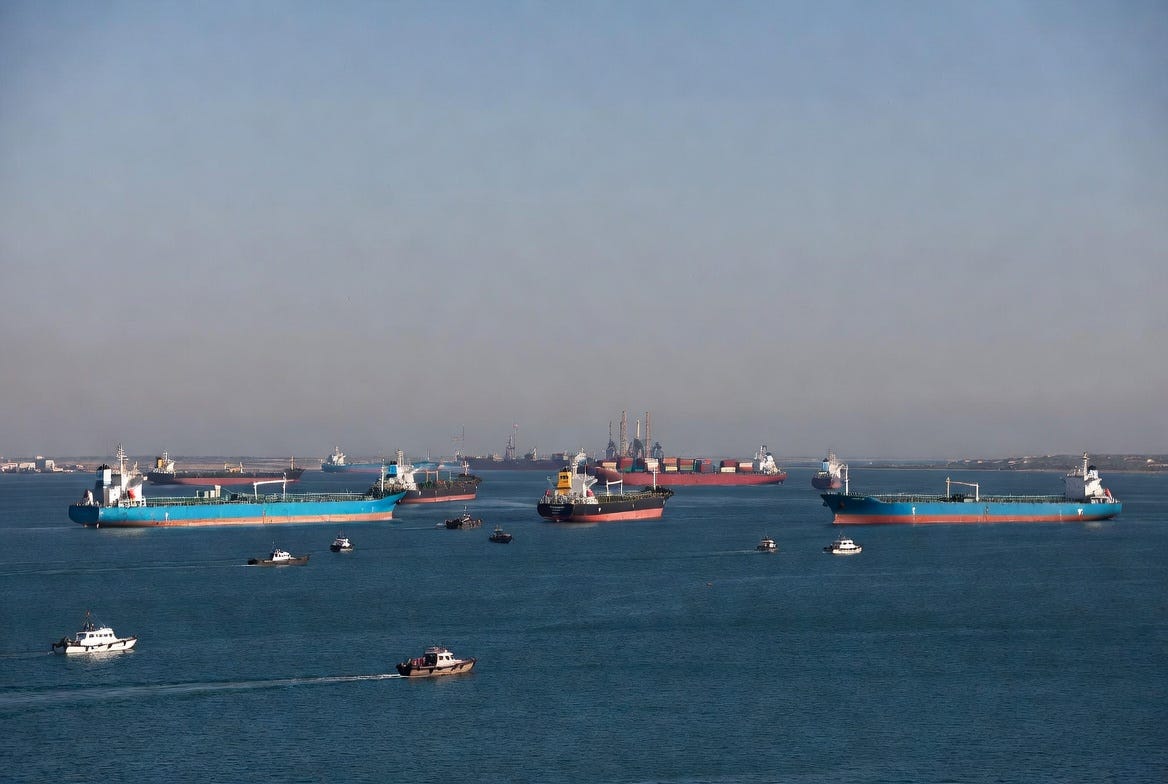
The Iran War has permanently damaged the reliability of the Strait of Hormuz as a global shipping lane
The most likely outcome of a settlement isn’t a triumphant return to open waters, but an insidious, “permanently bifurcated” strait where access is dictated by political alignment rather than freedom of navigation. Shipping analysts project that total traffic will likely max out at just 60% to 70% of prewar volumes. Under this fractured system, China-affiliated vessels will be allowed to move freely, while Western ships will be forced to secure complex, bilateral agreements with Tehran just to pass. We’ve already seen a preview of this exact movie in the Red Sea, where traffic collapsed by over half in early 2024 due to Houthi attacks and still hasn’t recovered more than two years later, proving that maritime chokepoints remain disrupted long after the shooting stops.
For your wallet and the broader economy, this means structural energy inflation is likely here to stay. While the current standoff hasn’t triggered a full-blown global recession, the lack of a prewar rebound means energy flows will remain restricted and expensive. Before the war, Hormuz carried 20% of the world’s oil and liquefied natural gas (LNG), and while neighbors like Saudi Arabia and the UAE are using pipelines to bypass the gulf, pipelines simply cannot carry everything—especially commodity products like LNG and fertilizer. Ultimately, Hormuz’s role as the world’s premier energy hub is permanently damaged; Gulf nations are already accelerating new pipeline projects for 2027 to cut it out entirely, with U.S. energy officials noting that while the region’s energy production remains vital, Iran has officially played its biggest blockade card, and the strategic importance of the Strait itself is officially in terminal decline.
Subscribe for free to receive our FREE Retirement Calculator and Guide
Disclaimer:
The information provided by The Market Dispatch is for educational and informational purposes only and should not be construed as financial, legal, or investment advice.
The Market Dispatch, its authors, and contributors are not financial advisors, brokers, or attorneys. Any opinions, analyses, or projections expressed are solely those of the authors and do not constitute specific recommendations for any individual.
Investing involves risk, including the potential loss of principal and capital. Past performance does not guarantee future results. Before making any financial decisions or investments, you should consult with a qualified financial advisor or other professional who understands your personal circumstances.
By reading this newsletter or using any related materials, you acknowledge and agree that The Market Dispatch and its team will not be held liable for any loss, damage, or expense incurred as a result of reliance on the information provided.
The crypto seizure section is the one worth sitting with. “Just outright grabbed the wallets” is a sovereign-scale version of something most individual savers never really price. Every place you hold money carries a counterparty, and that counterparty has its own incentives and failure modes.
The takeaway isn’t “self-custody or die.” A sanctioned state is not a useful template for a family managing its savings. The takeaway is narrower and more useful. Know exactly who can touch what you own, under what conditions, and be honest with yourself about the answer. For most people it’s an exchange or a broker, and that can be perfectly fine. What isn’t fine is not knowing.
I feel, at least for the average person, inflation numbers and CPI have become so disconnected with reality after we’ve seen prices continue to skyrocket with seemingly no signs of dropping. Although they think we won’t notice, the “small” price bumps eventually do add up and before we know it, price has doubled.