

Heading into the holiday-shortened Thanksgiving week, the stock market’s once-impressive 2026 rally is hanging by a thread. Following a bruising Friday session, Wall Street’s focus has shifted abruptly from hunting for bargains to playing pure defense.
Investors unloaded major artificial-intelligence beneficiaries—including Nvidia, Sandisk, and Micron—while even traditional defensive sectors like healthcare offered little shelter. By Friday’s close, the Dow Jones Industrial Average finished below the 50,000 mark for a second consecutive day, officially joining the S&P 500 and Nasdaq Composite in correction territory (down at least 10% from their record highs).
Subscribe for free to receive our FREE Retirement Calculator and Guide
The damage beneath the surface is even starker:
Widespread Drawdowns: Roughly 64% of S&P 500 companies closed at least 20% below their all-time highs on Friday. Within the battered information-technology sector, that figure hit an astonishing 87%.
Vanishing Annual Gains: Year-to-date progress has nearly evaporated. The S&P 500 is clinging to a 1% gain for 2026, the Dow is up just 0.2%, and the Nasdaq Composite has slipped into the red, down 2.7%.
Bear Market Territory: The tech-heavy Nasdaq-100 is down 0.9% on the year, sitting more than 19% off its peak and right on the doorstep of a bear market.
A Buyers’ Strike Meets Shifting Politics
Earlier in the week, there was optimism that strong earnings from Nvidia and Anthropic’s landmark IPO would stabilize sentiment and spark a familiar wave of dip-buying. Instead, Wall Street hit a buyers’ strike.
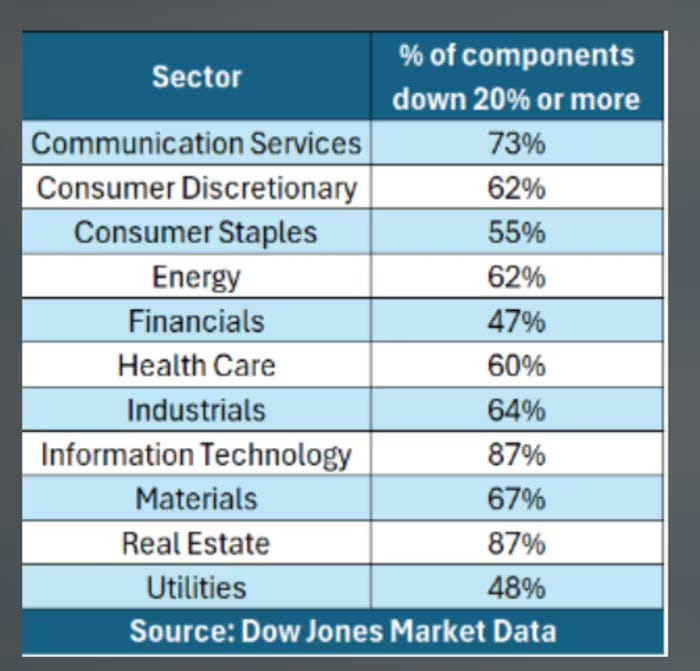
87& of all the Technology stocks in the S&P500 index are now 20% or further down from their all time highs (Source: Dow Jones Market Data)
For much of the past year and a half—most notably following the April 2025 tariff pause—investors grew accustomed to rapid market rebounds triggered by executive actions or policy shifts. However, with the recent midterm elections handing control of both the House and Senate to Democrats, traders recognize that unilateral policy catalysts to rescue market sentiment are off the table.
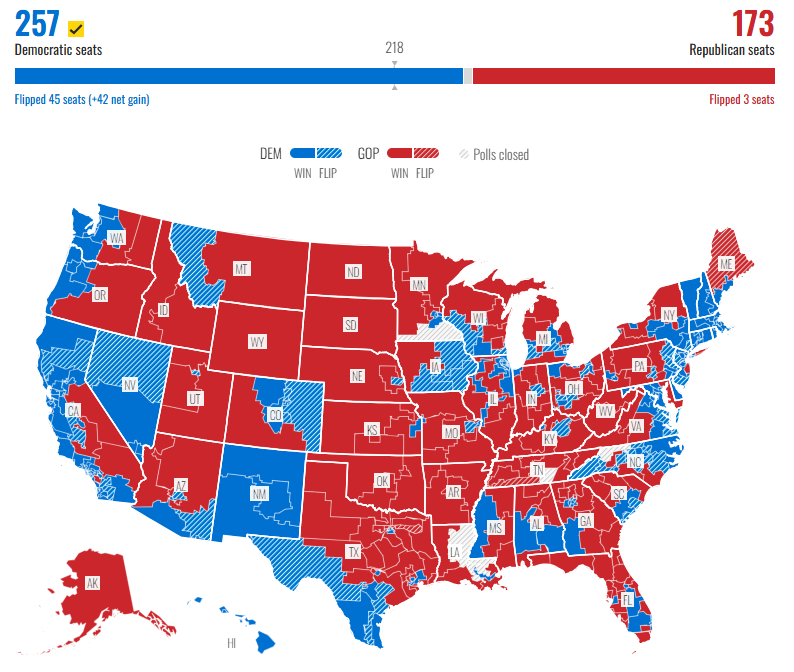
Democrats flipped 45 Republican House seats to win back control of the House, while at the same time winning back control of the Senate as well (Chart: NBC News)
More importantly, the midterm results highlighted intense voter pushback against the rapid expansion of energy-hungry data centers driving up local utility bills. Combined with fresh scrutiny in Washington over semiconductor exports to China, investors are treating the election as the moment the punchbowl was pulled from the AI party.
Subscribe for free to receive our FREE Retirement Calculator and Guide
Resetting Valuations and Interest Rate Fears
This reassessment has compressed tech valuations dramatically. The S&P 500’s technology sector is now trading at a forward price-to-earnings ratio of 16.3—down from 22 at the start of 2026, and its lowest level since the March 2020 pandemic crash. Even though consensus estimates still project 16% to 17% S&P 500 earnings growth next year, confidence in how long those margins can hold is fading.
Adding to the anxiety is the Federal Reserve. Policymakers, including Fed Governor Christopher Waller, have signaled that bringing inflation firmly back to the 2% target may require additional economic friction. Markets are currently pricing in back-to-back interest rate hikes starting at the Fed’s December 9 meeting and continuing into January, raising fears that the central bank could overtighten and stall economic growth.
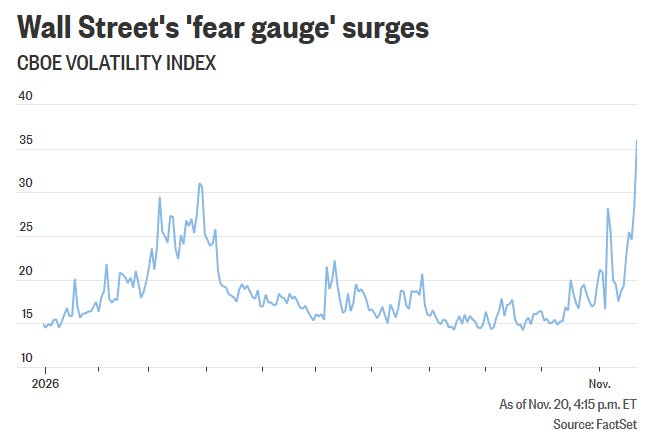
The CBOE Volatility Index has surged dramatically since October as traders begin panic-selling (Source: FactSet)
Not even a nearly 20% drop in global oil prices this month has calmed nerves. Wall Street’s “fear gauge”—the Cboe Volatility Index (VIX)—has surged over 50% in November, breaking above 30 on Friday and signaling heightened turbulence ahead.
What To Do Going Forward
When volatility spikes and market leadership unravels, trying to catch falling knives rarely pays off. For your personal portfolio, this is a time to prioritize capital preservation over aggressive dip-buying. Review your asset allocation to ensure a single sector—especially high-beta technology—doesn’t carry outsized weight in your net worth. Keep your emergency cash and near-term liquidity parked in high-yielding, safe instruments, and avoid making emotional trades driven by daily headlines. Staying diversified and patient allows you to weather the storm until clear earnings catalysts return.
Subscribe for free to receive our FREE Retirement Calculator and Guide
Follow along on social media for key updates:
Instagram: TheMarketDispatch
Disclaimer:
The information provided by The Market Dispatch is for educational and informational purposes only and should not be construed as financial, legal, or investment advice.
The Market Dispatch, its authors, and contributors are not financial advisors, brokers, or attorneys. Any opinions, analyses, or projections expressed are solely those of the authors and do not constitute specific recommendations for any individual.
Investing involves risk, including the potential loss of principal and capital. Past performance does not guarantee future results. Before making any financial decisions or investments, you should consult with a qualified financial advisor or other professional who understands your personal circumstances.
By reading this newsletter or using any related materials, you acknowledge and agree that The Market Dispatch and its team will not be held liable for any loss, damage, or expense incurred as a result of reliance on the information provided.
64% of the S&P 500 at least 20% below its high while the index is only up 1% for the year is a strange split - is this a breadth washout, or is the index just being held up by the few names left standing?
A forward P/E of 16.3 against about 22 in January is a bigger reset than the index moves suggest. Consensus still has the S&P 500 growing earnings 16 to 17% next year, so either those estimates come down or tech is now cheap against its own history. When the multiple falls faster than the estimates move, a cash flow valuation is the most useful tool you have.