

Navigating current market dynamics requires looking past headline reactions to understand the underlying structural shifts across foreign policy, industrial capacity, and policy gridlock. In energy markets, a sharp drop in crude oil prices mask a widening gap between Wall Street’s election optimism and escalating military friction in the Middle East, where potential supply shocks continue to hang over consumer inflation. Meanwhile, on Wall Street, a fresh political divide on Capitol Hill is forcing investors to rethink broad equity bets, as historical valuation twists in healthcare show why selective stock picking is replacing index-wide momentum.
Subscribe for free to receive our FREE Retirement Calculator and Guide
Market Hopes for Peace Run Into Harsh Military Realities as the U.S.–Iran Conflict Risks Surging Energy Costs
Your budget might be celebrating a temporary reprieve at the pump, but financial markets are wildly mispricing the true geopolitical risk. Crude oil plunged over 16% this week following a Democratic midterm sweep, with Vice President Vance blaming the election loss directly on the war. Wall Street quickly bought into the narrative that incoming congressional majorities would force a diplomatic exit. Yet that optimism ignores basic political calendar math: Democrats cannot pass a war powers resolution until taking office in January. Even then, President Trump holds veto power and retains full military authority to strike immediately, leaving energy prices dangerously exposed.
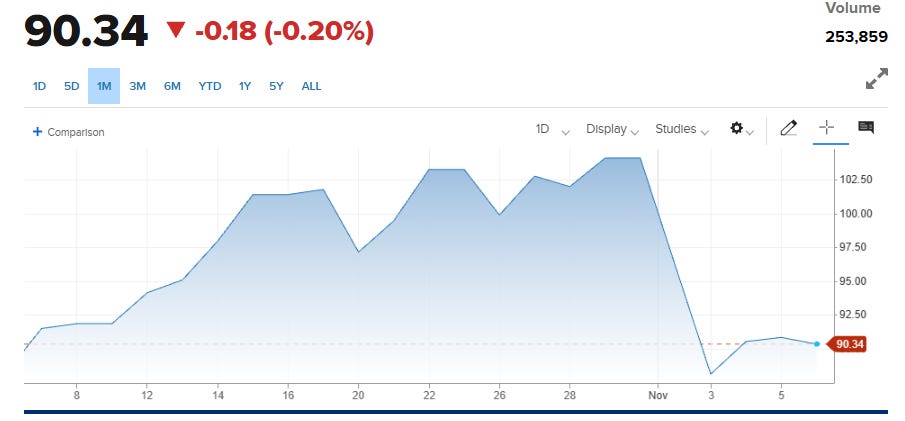
Oil prices dropped sharply this week after the Democrats retook control of Congress (Source: CNBC)
On the ground in the Persian Gulf, military reality paints a far darker picture than traders seem to realize. Iran-backed Houthi forces continue firing missiles into Saudi Arabia, oil tankers near Oman face deadly attacks, and a third U.S. aircraft carrier strike group is currently steaming toward the region. Energy analysts now see an 80% probability of renewed fighting as diplomatic talks stall over Iran’s nuclear program. President Trump openly reiterated that the administration is “locked and loaded” to act, emphasizing that preventing a nuclear-armed Tehran remains an absolute priority regardless of political fallout or election results.
For your wallet, a military spark in the Middle East will quickly reverse this week’s drop in energy markets. With Brent crude hovering around $97 and U.S. crude near $90, analysts warn that renewed combat will push oil back above $100 per barrel. That surge would instantly spill over into higher prices for retail gasoline, diesel, and airline ticket costs. While Congress might eventually use December budget deadlines to challenge long-term war funding, those political negotiations cannot prevent an immediate price shock if missiles fly before January.
Subscribe for free to receive our FREE Retirement Calculator and Guide
Record Factory Production Powered by Artificial Intelligence Runs Into Supply Bottlenecks and Hot Inflation
American factories are pumping out goods at a rate not seen in half a decade, but sticky inflation and supply chain gridlock are threatening to spoil the party. The Institute for Supply Management’s manufacturing index rose to 55.5% in October, marking ten consecutive months of expansion. A massive wave of corporate investment in artificial intelligence infrastructure has fueled a five-year high in production alongside four straight months of factory hiring. Yet despite strong demand and rising order books, corporate leaders remain deeply uneasy because high oil prices tied to the Iran war, lingering tariffs, and critical material shortages are severely capping their operational capacity.
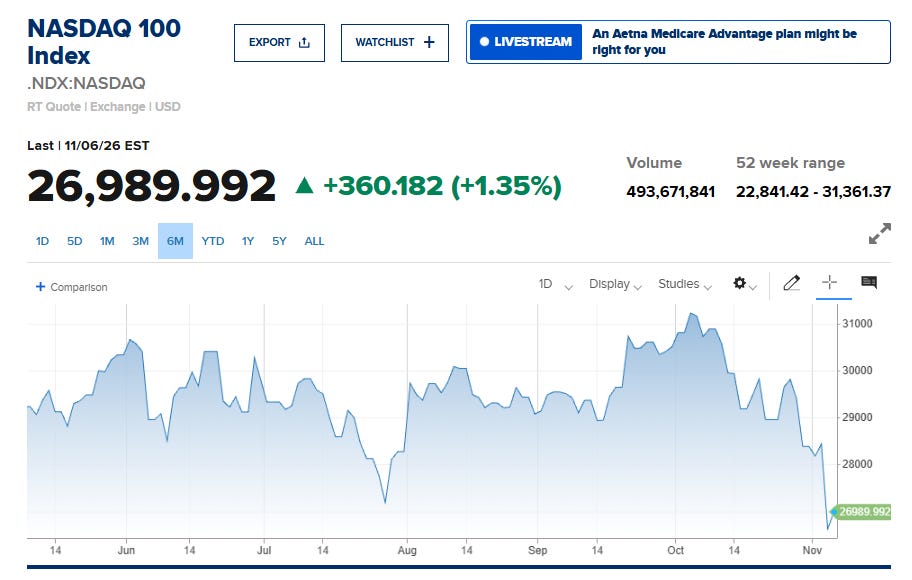
The AI Buildout has led to see-sawing prices for the Tech-heavy Nasdaq-100 index, as traders try to figure out how this will play out in the real economy (Chart: CNBC)
This collision of roaring demand and supply constraints is keeping the cost of finished goods uncomfortably high. A key measure of factory input inflation stayed near a four-year peak as companies paid escalating prices for energy, parts, and specialized electronics. Executive quotes from the survey highlight severe cost pressures, with machinery makers reporting that specific components have doubled in price over just six months. Delivery times are stretching out as factories struggle to secure raw materials, forcing businesses to pass those elevated equipment and manufacturing expenses directly down the supply chain to end consumers.
Looking ahead, this combination of accelerating industrial output and persistent cost pressures presents a serious dilemma for interest rate policy. Economic momentum is solid, but factory leaders report that customers are reluctant to make long-term commitments amidst economic uncertainty out of Washington. Economists warn that robust manufacturing activity paired with stubborn price growth gives the Federal Reserve little room to offer interest rate relief. So long as input costs stay hot, borrowing costs for expanding businesses and everyday consumers will remain stuck at elevated levels.
Subscribe for free to receive our FREE Retirement Calculator and Guide
Healthcare Stocks Face Political Gridlock and Valuation Headwinds Following Democratic Congressional Sweep
Healthcare investors are bracing for a prolonged period of political gridlock as incoming Democratic majorities in Congress prepare to clash with the White House. While the Health Care Select Sector ETF (XLV) initially surged 3% right after Election Day, it quickly gave up those gains to end the week virtually flat. Sector analysts warn that with divided government locked in through 2028, major legislative moves or regulatory rollbacks are unlikely to pass over the next two years. That leaves healthcare stocks struggling for clear upward momentum, even though the sector has outperformed the broader S&P 500 by nearly 9 percentage points since January 2025.
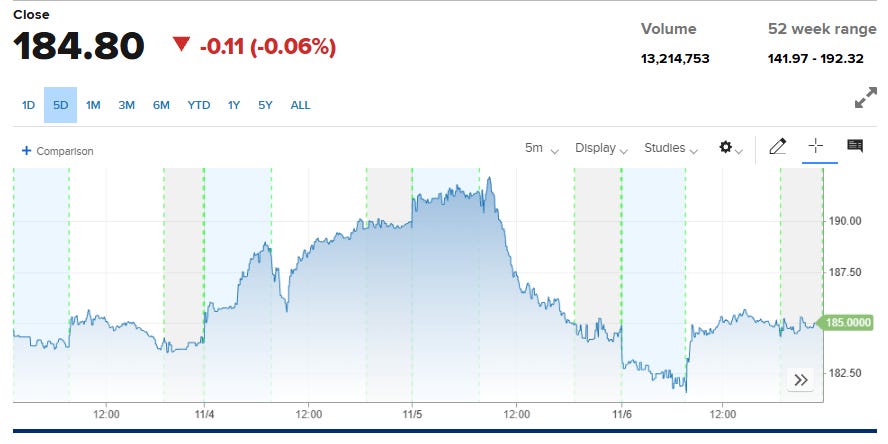
The Health Care Select Sector ETF (XLV) initially surged 3% right after Election Day, but gave up all its gains by the end of the week (Chart: CNBC)
Beyond Capitol Hill standoffs, stock valuations within the healthcare space have grown unusually distorted, making broad index investing a risky bet. For the first time in two decades, traditional pharmaceutical stocks are trading at higher valuation multiples than the technology sector. That historical anomaly is prompting healthcare strategists to back away from big pharma and advise a far more selective, stock-picking approach. Instead of buying broad sector funds, analysts recommend focusing on beaten-down subsectors like medical technology and device makers, many of which are currently trading near multi-year lows.
For your portfolio, the primary takeaway is that the easy gains for broad healthcare funds are likely behind us for this political cycle. Industry experts suggest that the next major catalyst for sweeping regulatory changes or sector-wide rallies won’t arrive until after the 2028 presidential election. Until then, index investors should expect range-bound performance across major healthcare funds, while selective stock pickers will need to carefully separate overpriced drug makers from discounted medical device companies to generate meaningful investment returns.
Follow along on social media for key updates:
Instagram: TheMarketDispatch
Disclaimer:
The information provided by The Market Dispatch is for educational and informational purposes only and should not be construed as financial, legal, or investment advice.
The Market Dispatch, its authors, and contributors are not financial advisors, brokers, or attorneys. Any opinions, analyses, or projections expressed are solely those of the authors and do not constitute specific recommendations for any individual.
Investing involves risk, including the potential loss of principal and capital. Past performance does not guarantee future results. Before making any financial decisions or investments, you should consult with a qualified financial advisor or other professional who understands your personal circumstances.
By reading this newsletter or using any related materials, you acknowledge and agree that The Market Dispatch and its team will not be held liable for any loss, damage, or expense incurred as a result of reliance on the information provided.
The oil line is the one I keep staring at too. Crude can drop on one headline while the risk of a supply shock is still there, because the price shows today’s barrels, not tomorrow’s. On a chart that just looks like a calm red candle. Nice clear brief as always.