

Financial markets and household budgets are both navigating major structural shifts this week, from central bank calendars to executive boardrooms and tax-advantaged retirement accounts. In this issue of The Market Dispatch, we break down what a quieter central bank means for market volatility, how to evaluate an individual stock drop after a founder leaves, and how to prepare your paycheck for higher retirement limits.
Subscribe for free to receive our FREE Retirement Calculator and Guide
The Federal Reserve Scales Back Rate Votes to Reduce Its Footprint on Wall Street
If you feel like every week brings a new Federal Reserve headline moving mortgage rates and stock prices, the central bank is finally hitting the brakes. Chairman Kevin Warsh announced Thursday that policymakers will skip a vote on interest rates during their October 2027 meeting. Instead of deciding on borrowing costs or issuing a post-meeting statement, the Federal Open Market Committee will use those two days to debate broad, long-term monetary strategy. This breaks from the traditional schedule of eight annual rate votes, cutting 2027 down to seven decision meetings and shifting the year’s final vote from December into November.
Warsh is making this shift because he believes the central bank has become too loud and too predictable for its own good. He has long criticized past Fed leadership for offering heavy forward guidance that essentially handcuffed officials when economic conditions changed. Since taking the helm, Warsh has systematically shrunk the central bank’s market footprint by trimming press conferences from 45 minutes down to half an hour and drastically shortening post-meeting statements. He even plans to expand this strategy in 2028 by adding a second nonvoting meeting, giving his team more breathing room to focus on big-picture questions rather than constant market babysitting.
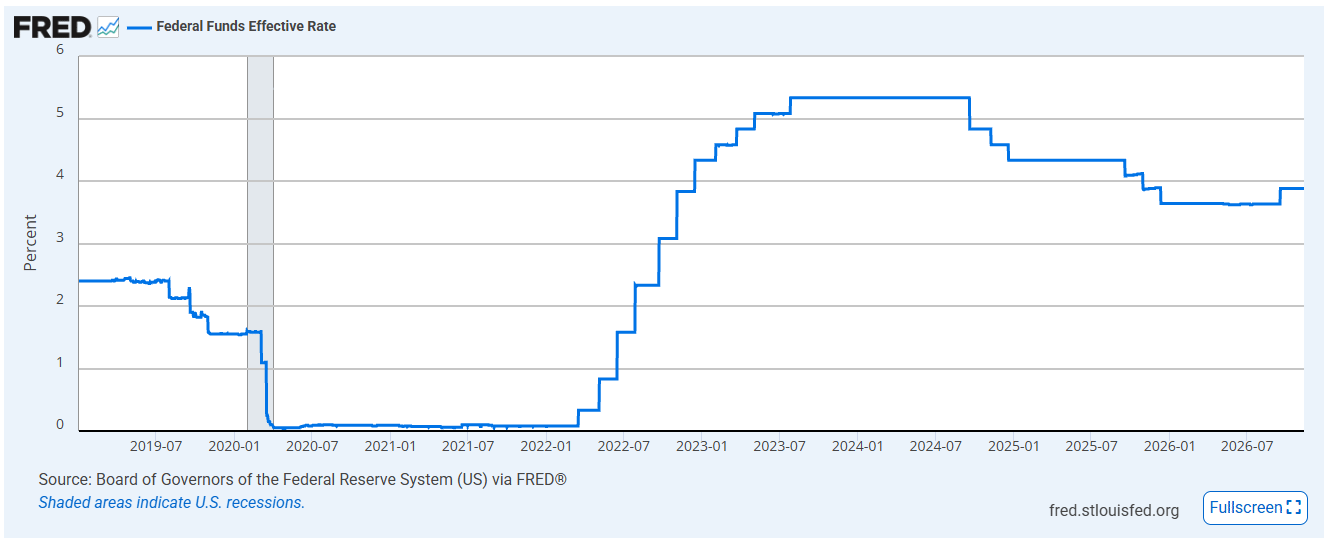
The Federal Reserve has been raising rates since 2022 to combat inflation, as it spiked after the Covid-19 pandemic (Chart: Federal Reserve Bank)
For your wallet and your portfolio, fewer rate votes mean fewer artificial volatility spikes driven by Wall Street guessing games. While the Fed still meets next month in December and kicks off 2027 in late January, the long-term message is clear. Policymakers want to step out of the daily spotlight so markets stop hanging on every word from Washington. Over time, a quieter Federal Reserve could force investors to focus back on actual economic fundamentals rather than waiting for the next central bank rescue.
Nvidia’s Shock CEO Exit Tests a Classic Wall Street Rule on Buying the Dip
Watching a market darling drop 31% from its October high naturally triggers the urge to hunt for a bargain. That temptation hit overdrive Thursday after Nvidia co-founder Jensen Huang resigned as CEO amid intelligence revelations linking him romantically to an alleged Chinese spy. Shares fell more than 5% on the news, leaving everyday investors wondering if this steep pullback is a golden buying opportunity or a warning sign. While buying broad market dips works historically because indexes eventually recover to new highs, individual stocks carry no such guarantee. Before jumping into a roughly $4 trillion giant in transition, you have to ask whether losing its visionary leader changes the core reason you own it.
Wall Street pros are sharply divided on what happens next when a generational founder steps aside after 33 years. Historical research from Bain & Company shows that founder-led businesses vastly outperform their peers over time, and even tech titans like Apple and Microsoft saw their growth slow after replacing original leaders. Some fund managers view a visionary founder’s grit and execution as literally irreplaceable, forcing them to walk away regardless of how cheap the stock looks. On the flip side, others point out that getting a massive growth engine at such a steep discount is a rare, once-in-a-decade setup.
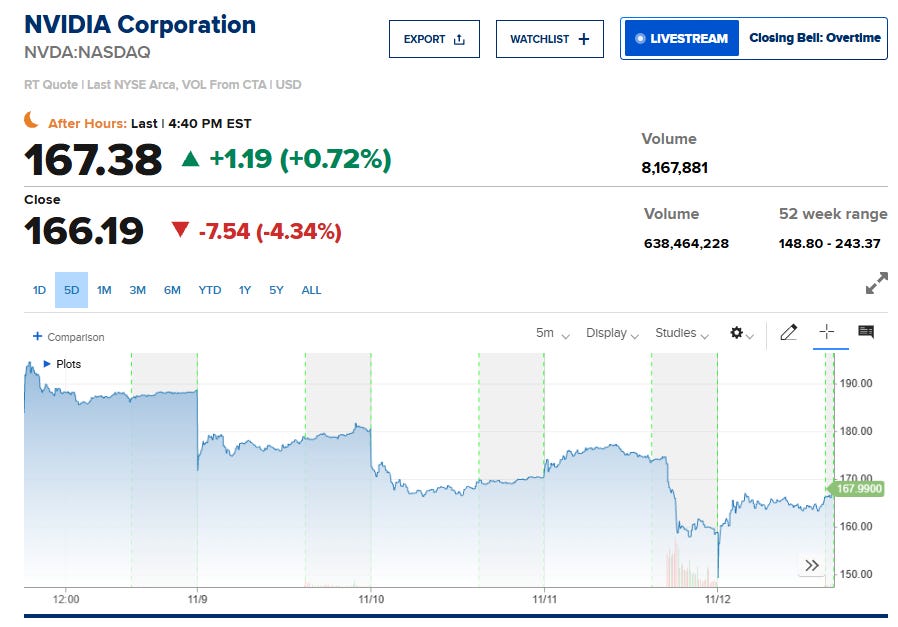
Nvidia shares fell dramatically last week as news broke out of Jensen Huang’s resignation (Chart: CNBC)
For your own portfolio, the smartest move right now is checking your risk tolerance before touching the buy button. If Nvidia already takes up so much space in your account that a sudden drop keeps you awake at night, trimming your exposure makes total sense. While underlying global demand for artificial intelligence chips remains intact ahead of next week’s earnings report, nobody knows yet if Nvidia can maintain its breakneck pace without Huang at the wheel.
Subscribe for free to receive our FREE Retirement Calculator and Guide
The IRS Raises 2027 Retirement Limits, Giving Savers More Room to Shelter Income
If you want to lower your tax bill and build wealth faster next year, Uncle Sam just handed you a bigger bucket. The IRS announced Thursday that employee contribution limits for 401(k), 403(b), and most 457 plans will climb to $25,500 in 2027, up $1,000 from this year’s cap. Older savers get even more breathing room. Workers age 50 and up can tuck away an extra $8,500 in catch-up contributions, while those between 60 and 63 qualify for a super-charged $11,750 catch-up under Secure 2.0 rules. Meanwhile, traditional and Roth IRA limits will hold steady at $7,500, with an extra $1,100 allowed for anyone 50 or older.
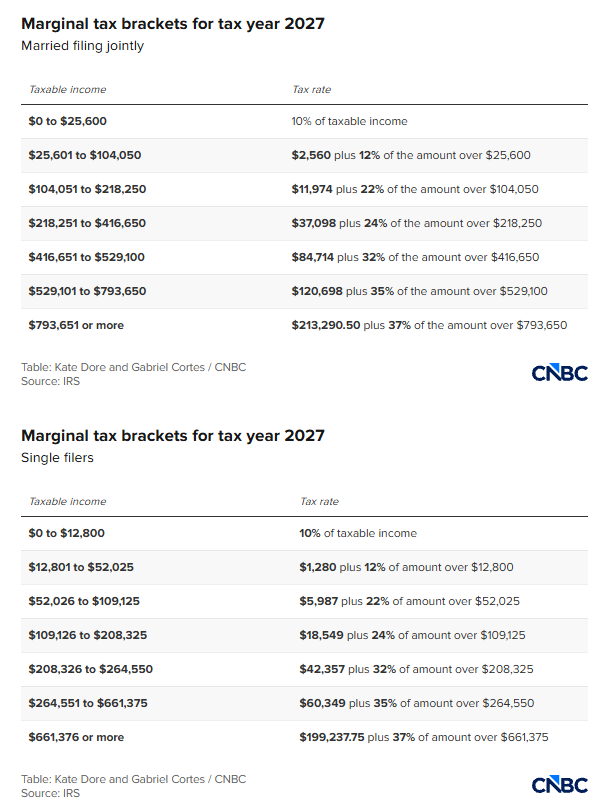
The IRS also released its new income tax brackets for 2027, slightly adjusting income thresholds to account for inflation (Chart: CNBC)
Before chasing those higher ceilings, make sure you aren’t leaving free money on the table right now. Vanguard data shows only 14% of workers actually max out their workplace plans, while Fidelity found that nearly one in five employees still fail to contribute enough to capture their full company match. Financial planners stress that securing your entire employer match is the undisputed first step of retirement planning. Beyond that baseline, Vanguard recommends aiming for a total savings rate of 12% to 15% of your pay, combining both your own deferrals and any company deposits.
To take full advantage of these new 2027 rules, mark your calendar for December. Payroll departments often need one or two pay cycles to process updates, so adjusting your deferral percentage next month ensures your higher contributions kick in on your very first January paycheck. Even if maxing out feels out of reach, simply bumping your savings rate by 1% each year builds massive long-term wealth without noticeably shrinking your take-home pay.
Follow along on social media for key updates:
Instagram: TheMarketDispatch
Disclaimer:
The information provided by The Market Dispatch is for educational and informational purposes only and should not be construed as financial, legal, or investment advice.
The Market Dispatch, its authors, and contributors are not financial advisors, brokers, or attorneys. Any opinions, analyses, or projections expressed are solely those of the authors and do not constitute specific recommendations for any individual.
Investing involves risk, including the potential loss of principal and capital. Past performance does not guarantee future results. Before making any financial decisions or investments, you should consult with a qualified financial advisor or other professional who understands your personal circumstances.
By reading this newsletter or using any related materials, you acknowledge and agree that The Market Dispatch and its team will not be held liable for any loss, damage, or expense incurred as a result of reliance on the information provided.
Really useful issue — three very different stories, but they connect around the same idea: less noise, more fundamentals.
On the Fed: Warsh scaling back to 7 decision meetings in 2027, skipping the October vote for a strategy discussion, and moving the final vote from December to November is a big structural shift. I agree with the logic — the Fed had become too loud and too predictable, and heavy forward guidance handcuffed officials when conditions changed. Trimming press conferences from 45 to 30 minutes and shortening statements is part of the same philosophy.
For portfolios, fewer votes should mean fewer artificial volatility spikes from Wall Street guessing games. But there's a trade-off worth naming: fewer decision meetings concentrates risk. Each meeting carries more weight, and if inflation surprises between meetings, the market has to wait longer — or overreact in anticipation. A quieter Fed reduces noise, but it can increase whiplash when it does speak.
On Nvidia: the principle here is right, even if this specific story needs verification. Buying the dip works historically for broad indexes because indexes recover to new highs — losers drop out, winners come in. Individual stocks carry no such guarantee.
The Bain research you cite is the key point: founder-led businesses vastly outperform over time, and even Apple and Microsoft saw growth slow after replacing original leaders. Losing a visionary founder after 33 years doesn't just change the price, it changes the thesis. The right question isn't "is it cheap?" It's "does losing Huang change the core reason I own it?" And if Nvidia already takes up so much space in your account that a drop keeps you awake at night, trimming is rational regardless of valuation. I would want to see an official Nvidia filing or primary-source reporting before treating the resignation details as confirmed.
On the IRS limits: this is the most actionable part. 401(k) / 403(b) / 457 to $25,500 in 2027, +$8,500 catch-up for 50+, +$11,750 super catch-up for 60-63 under SECURE 2.0, IRA steady at $7,500 + $1,100 for 50+. But the stats you cite are the real story: only 14% max out according to Vanguard, and nearly 1 in 5 miss their full company match according to Fidelity.
The order matters: secure the full match first — that's an instant 100% return — then aim for 12-15% total savings rate including employer contributions, then think about maxing. And the December payroll tip is spot on. HR needs 1-2 pay cycles, so adjusting next month means higher contributions hit on the very first January paycheck. Even bumping 1% per year compounds massively without noticeably shrinking take-home pay
Interesting breakdown. The NVDA situation is a good reminder that a big drop doesn't automatically make a stock a good buy.
I've seen plenty of stocks look cheap after a selloff, only to keep making lower highs and lower lows.
That's why I focus on price structure and relative strength before even thinking about an entry.
Curious, would you wait for NVDA to rebuild a proper base, or would improving fundamentals alone be enough to consider buying the dip?