

If you have been watching the housing market lately, the recent movement in borrowing costs likely caught your attention. The average 30-year fixed mortgage rate recently spiked to 7.45%, reaching its highest mark since April 2024. Meanwhile, survey figures from Freddie Mac show application rates climbing past 7%, levels not seen since early 2025.
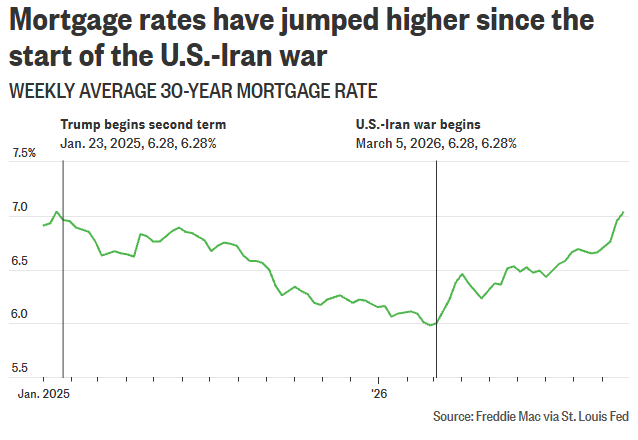
Mortgage rates had been decreasing since the end of 2024. However, the Iran War increased investor’s inflation expectations, driving rates higher again.
This swift uptick has reignited a question many buyers hoped was behind them: could mortgage rates actually touch 8% again?
While economists view 8% as possible rather than probable, understanding how we got here requires looking at bond market dynamics. Mortgage rates rarely move in a direct line with the Federal Reserve’s benchmark short-term policy rate—which was recently adjusted to a range of 3.75% to 4.00%. Instead, they track the yield on the 10-year U.S. Treasury note, which recently hit multi-year highs as bond investors weighed geopolitical tensions in the Middle East and persistent energy-driven inflation.
Subscribe for free to receive our FREE Retirement Calculator and Guide
To bridge the gap between Treasury yields and mortgage rates, lenders add what is known as a spread. This premium covers originations, market liquidity, and the risk profile of mortgage-backed securities compared to government bonds. Currently, that spread sits around 200 basis points. For mortgage rates to push to 8%, that spread would need to widen significantly toward the 300-basis-point levels seen in mid-2023.
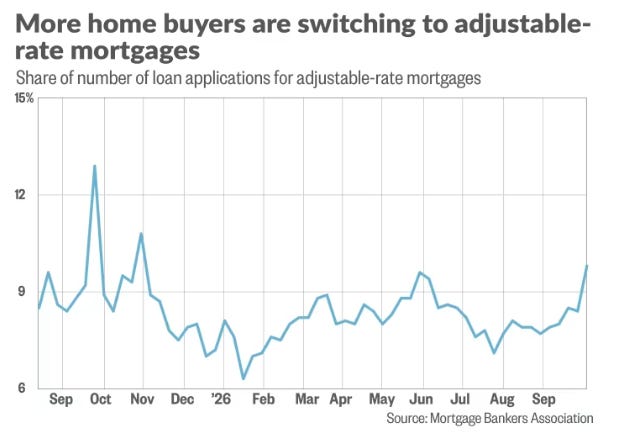
More and more buyers are opting for variable rate mortgages in the hopes that interest rates will go down. This is a risky move because, if interest rates actually go higher, they’ll be paying more for their mortgage every month.
The real-world consequences of these elevated rates are substantial. Industry data indicates that at a 7% rate, nearly 70% of American households are priced out of a median-priced home ($413,595). A move from 7% to 8% would price out an estimated 4.3 million additional households, creating friction across the broader market.
Subscribe for free to receive our FREE Retirement Calculator and Guide
In response, both buyers and sellers are adjusting their strategies:
Growing ARM Popularity: Applications for adjustable-rate mortgages (ARMs) have climbed to nearly 10% of total mortgage volume, their highest share since late 2023. While modern ARMs have stricter rate-cap protections than those pre-dating the 2008 financial crisis, they still expose buyers to eventual payment adjustments if broader market rates remain elevated.
Widespread Price Concessions: To move inventory, roughly 42% of active home listings have undergone price cuts. In fact, a small portion of sellers are now listing below their original purchase price.
Builder Discounts: Builders are aggressively discounting to clear inventory, driving the median price of new homes down nearly 6% year-over-year to $393,700.
What this means for you
Whether you are looking to purchase a home or managing an existing mortgage, volatility around the 7% to 8% mark requires a disciplined financial approach. If you are shopping for a home, budget around current rates rather than assuming rate cuts will arrive soon to refinance your loan.
For those considering an adjustable-rate mortgage to secure a lower initial payment, ensure your personal cash flow can comfortably absorb the maximum potential rate adjustment when the fixed period ends. Taking a conservative stance now protects your long-term balance sheet, regardless of how the bond market shifts this fall.
Subscribe for free to receive our FREE Retirement Calculator and Guide
Follow along on social media for key updates:
Instagram: TheMarketDispatch
Disclaimer:
The information provided by The Market Dispatch is for educational and informational purposes only and should not be construed as financial, legal, or investment advice.
The Market Dispatch, its authors, and contributors are not financial advisors, brokers, or attorneys. Any opinions, analyses, or projections expressed are solely those of the authors and do not constitute specific recommendations for any individual.
Investing involves risk, including the potential loss of principal and capital. Past performance does not guarantee future results. Before making any financial decisions or investments, you should consult with a qualified financial advisor or other professional who understands your personal circumstances.
By reading this newsletter or using any related materials, you acknowledge and agree that The Market Dispatch and its team will not be held liable for any loss, damage, or expense incurred as a result of reliance on the information provided.