

While a historic surge in corporate profits paradoxically flattened the stock market as tech giants sacrifice their cash flows for AI infrastructure, the Federal Reserve’s new leadership declared an aggressive "regime change" aimed at permanently killing the inflation tax. Meanwhile, on the geopolitical stage, European leaders are engineering a massive financial burden shift away from American taxpayers, ramping up independent defense spending to lock in regional stability.
Subscribe for free to receive our FREE Retirement Calculator and Guide
The Profit Paradox: Why Spectacular Corporate Earnings Are Failing to Lift the Stock Market
Wall Street is currently tangled in a strange dilemma: corporate profits are absolutely booming, yet the stock market has completely flattened out over the last two months. Heading into the second-quarter earnings season, companies are projected to post a stupendous 24% growth rate compared to last year, driving down the S&P 500’s forward price-to-earnings multiple from 22 to 20.7. While standard investing logic says surging profits should act as the life-giving essence of a bull market, historical data warns that when earnings shoot this far above their long-term trend lines, the market’s subsequent one-year performance usually ends up being highly disappointing.
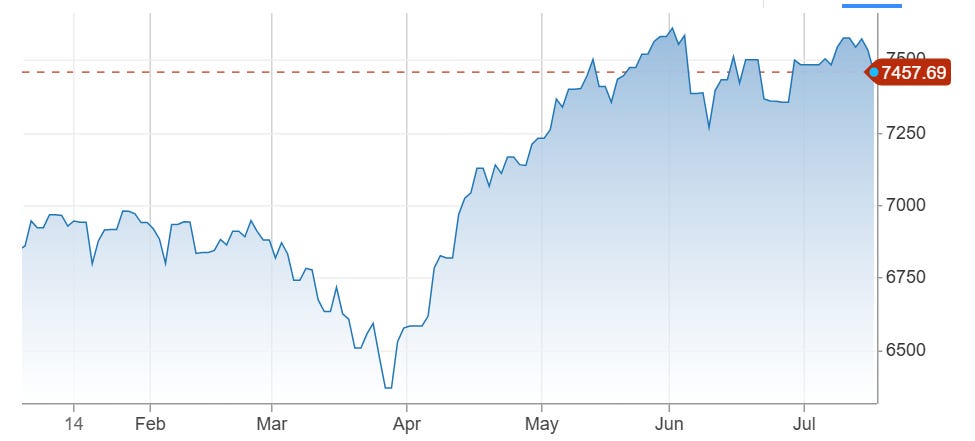
The S&P 500 index is up 8.95% Year-To-Date, close to the historical average yearly return
The traditional rules of valuation are being twisted by massive, high-stakes tech investments. The four giant “hyperscalers” dominating the index—Microsoft, Alphabet, Amazon, and Meta—are currently sacrificing virtually all of their free cash flow to build out computing capacity, funneling that cash directly to semiconductor makers. Because these tech titans are trading away their effortless, high-margin cash flows for heavy capital expenditures, they are losing their premium stock valuations, which in turn acts as a heavy anchor pulling down the broader index multiples.
For everyday investors, this sideways market churn signals that a major shift in earnings quality is underway, making stock prices hyper-sensitive to corporate forward guidance. Some tech subsectors have already tumbled 15% in just three weeks because the market is suddenly questioning whether this massive artificial intelligence spending boom is sustainable or simply front-loaded. With the median S&P 500 company seeing a respectable but fully priced-in 8% profit bump, your financial focus should shift away from the raw headline numbers and squarely onto how executive teams map out their spending plans for 2027 and beyond.
Subscribe for free to receive our FREE Retirement Calculator and Guide
The Central Bank Shakeup: Chairman Warsh Vows ‘Regime Change’ to Kill the Inflation Tax
Federal Reserve Chairman Kevin Warsh delivered a high-stakes message to Congress this week, promising a total structural overhaul at the central bank to permanently eliminate the inflation “tax” weighing down the American people. Just two months into his term, Warsh aggressively distance himself from past Fed practices, explicitly labeling the 2020 policy of allowing above-target inflation a total failure. Declaring that the central bank has absolutely zero tolerance for persistent price hikes, the new chairman announced a sweeping set of reforms across five newly created task forces designed to entirely remake how the Fed communicates, tracks data, and manages its balance sheet.
The “so what” for your wallet is that the era of the Fed tolerating high prices to artificially boost employment is officially dead. Under this new policy regime, the central bank’s sole, uncompromising focus is restoring absolute price stability, meaning borrowers and savers should prepare for a structurally tighter monetary environment until the cost of living drops. While families continue to face a heavy burden from a five-year inflation surge—compounded by volatile global energy prices—Warsh firmly asserted that long-term inflation is entirely a choice dictated by monetary policy, and he intends to break its back.
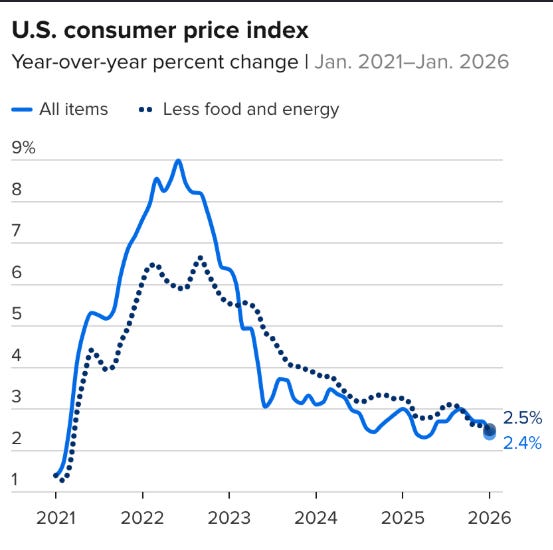
Inflation has been coming down from the highs we experienced in 2022, but prices remain elevated (Source: CNBC)
Despite the aggressive pivot toward tighter policy, the Fed chief emphasized that the underlying economy is expanding at a solid, resilient pace, driven by a massive boom in business investment. This economic strength is being heavily powered by the rapid, accelerating construction of data centers and immense corporate demand for artificial intelligence hardware and software. Warsh boldly predicted that this massive AI infrastructure buildout will ultimately trigger a wave of high productivity that acts as a powerful disinflationary force, helping to cool everyday expenses without plunging the broader economy into distress.
Subscribe for free to receive our FREE Retirement Calculator and Guide
The Victory Margin: Why Nordic Leaders Say Ukraine Has Already Won the War
Ukraine has effectively won its war against Russia by successfully preserving its independence, sovereignty, and territorial integrity through more than four years of a full-scale invasion. Speaking at a high-stakes NATO Summit in Ankara, Turkey, Finnish President Alexander Stubb pointed out that Moscow’s forces have advanced a mere 60 kilometers over the last four years—a stark contrast to their 1,400-kilometer march from Moscow to Berlin in World War II. Swedish Prime Minister Ulf Kristersson strongly backed this view, emphasizing that Russia is failing to manage the conflict as anticipated while Ukraine secures spectacular defensive successes.
What this means for the broader economy and the American taxpayer is a massive, structural “burden shift” in global military spending away from the United States and squarely onto Europe. Exactly one year after NATO allies committed to more than doubling their defense spending targets from 2% to 5% of GDP by 2035, European nations are aggressively accelerating their own defense-industrial bases to reduce their decades-long reliance on Washington’s military footprint. While the transition must be managed carefully to avoid destabilizing Western security, Europe’s independent financial mobilization—underscored by a massive 90 billion euro ($103 billion) loan package—signals that European taxpayers are finally picking up the tab for regional stability.
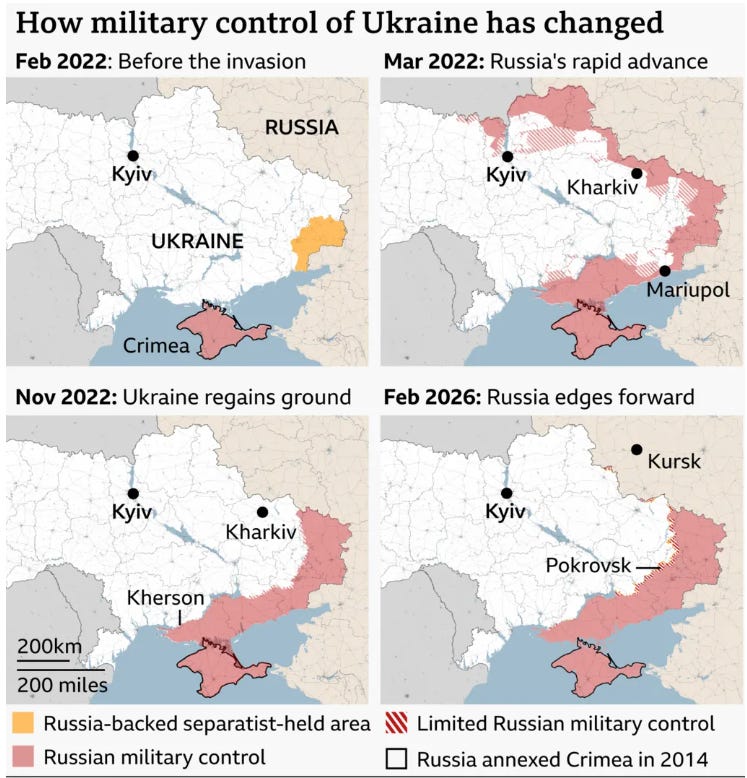
How military control of Ukraine has changed (Source: BBC)
For international markets and defense-sector investors, this defense buildup is no longer being driven by political rhetoric out of Washington, but by direct reaction to Russian aggression. This systemic transition, dubbed “NATO 3.0,” is unlocking a wave of long-term European defense procurement, such as Sweden moving forward with plans to supply Ukraine with Saab-made Gripen fighter jets. However, Nordic leaders warn that global markets shouldn’t get complacent; time will only remain on the West’s side if allies rapidly deliver the advanced air defense systems that Kyiv still urgently needs to protect its infrastructure.
Subscribe for free to receive our FREE Retirement Calculator and Guide
Follow along on social media for key updates:
Instagram: TheMarketDispatch
Disclaimer:
The information provided by The Market Dispatch is for educational and informational purposes only and should not be construed as financial, legal, or investment advice.
The Market Dispatch, its authors, and contributors are not financial advisors, brokers, or attorneys. Any opinions, analyses, or projections expressed are solely those of the authors and do not constitute specific recommendations for any individual.
Investing involves risk, including the potential loss of principal and capital. Past performance does not guarantee future results. Before making any financial decisions or investments, you should consult with a qualified financial advisor or other professional who understands your personal circumstances.
By reading this newsletter or using any related materials, you acknowledge and agree that The Market Dispatch and its team will not be held liable for any loss, damage, or expense incurred as a result of reliance on the information provided.
That's exactly why I try to ignore the quarterly noise. Expectations move share prices in the short term, but sustainable earnings growth creates wealth over the long run. Patience usually wins.