

At the Federal Reserve, Chairman Kevin Warsh sparked widespread market speculation by framing recent rate moves as removing a "dose of accommodation," signaling a potentially open-ended path for further interest rate hikes. Meanwhile, in the fixed-income arena, Treasury Secretary Scott Bessent’s expanded bond buybacks failed to stem a sharp selloff, pushing 10-year Treasury yields toward 5% as surging oil prices and wholesale inflation pressures raise borrowing costs across the economy. On the geopolitical front, President Donald Trump announced a historic security agreement with Denmark and Greenland, permanently securing North American defense geography at zero cost to U.S. taxpayers while blocking Russian and Chinese expansion in the Arctic.
Subscribe for free to receive our FREE Retirement Calculator and Guide
Federal Reserve Chairman Signals Potential Shift Toward Further Rate Hikes
Federal Reserve Chairman Kevin Warsh described the central bank’s recent quarter-point rate hike not as a standard tightening of monetary policy, but as removing “a dose of accommodation.” By signaling that current policy remains stimulative in a strengthening economy, Warsh ignited widespread debate across Wall Street regarding how many additional rate increases may lie ahead. Furthermore, he explicitly downplayed the importance of the traditional “neutral rate” benchmark, calling it useful academically but lacking operational effect on current policy decisions.
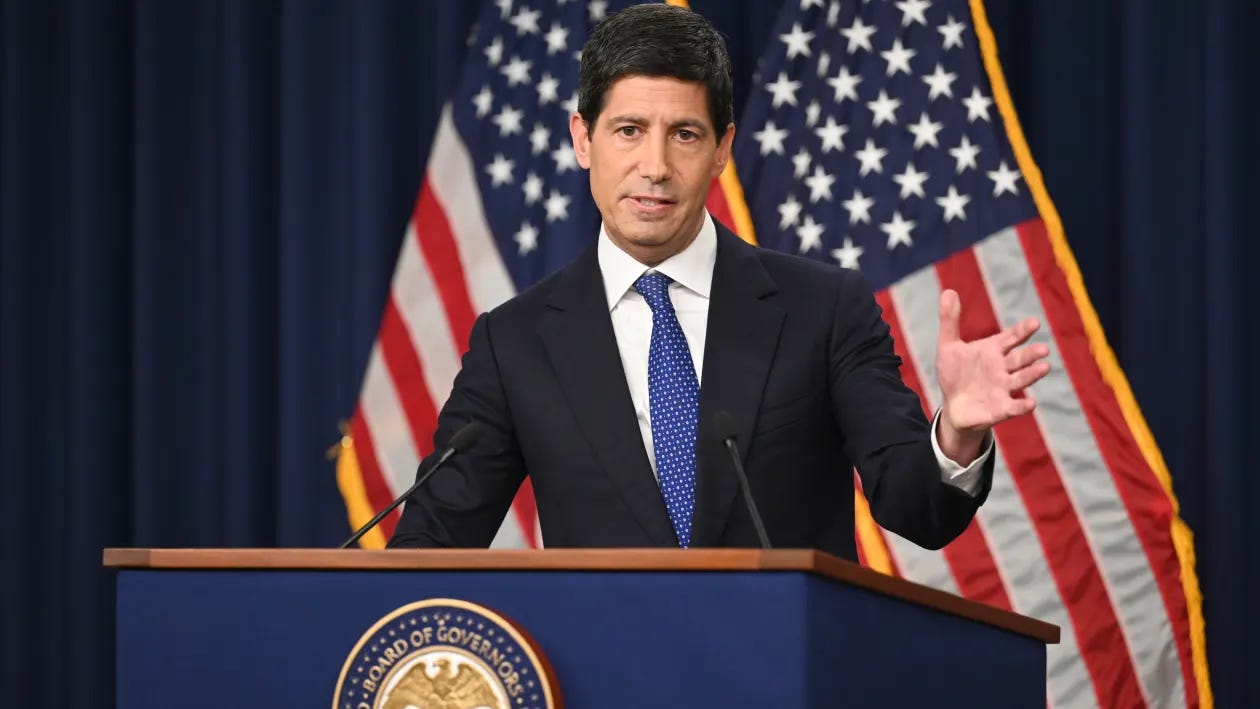
Federal Reserve Chairman Kevin Warsh addresses reporters during a press conference (Source: CNBC)
For consumers and investors, this shift in central bank framing could directly impact borrowing costs on everything from mortgages to business loans. Wall Street firms are already adjusting their forecasts, with expectations rising for additional rate hikes at upcoming meetings and futures markets pricing in a benchmark rate around 4.635% near the end of 2027. If the Fed continues along this path, it will effectively roll back previous interest rate cuts, creating a less accommodative environment for loans and credit.
While some market analysts view this move as an open-ended path toward significant tightening, others view it simply as unwinding temporary insurance cuts delivered late last year. Regardless of whether this represents a prolonged campaign or a quick calibration, the key takeaway for your finances is clear: interest rates are trending higher, making debt more expensive to service and raising the bar for investment returns.
Subscribe for free to receive our FREE Retirement Calculator and Guide
Treasury Yields Surge as Bond Market Rout Outpaces Government Interventions and Rate Hike Concerns Mount
The selloff across the U.S. government debt market deepened significantly as a fresh bond auction and Secretary Scott Bessent’s expanded Treasury buybacks failed to restore stability. Benchmark 10-year Treasury yields surged 12 basis points to 4.96%—nearing the critical 5% mark and reaching levels not seen in roughly three years. Despite the Treasury’s attempt to draw a line in the sand by purchasing $5.2 billion in long-dated bonds, the scale of the buyback underwhelmed traders who had priced in a much larger intervention. Compounded by a soft $22 billion 30-year bond auction that saw yields top 5.3%, fixed-income markets globally are signaling that the broad cost of borrowing money is rising rapidly.
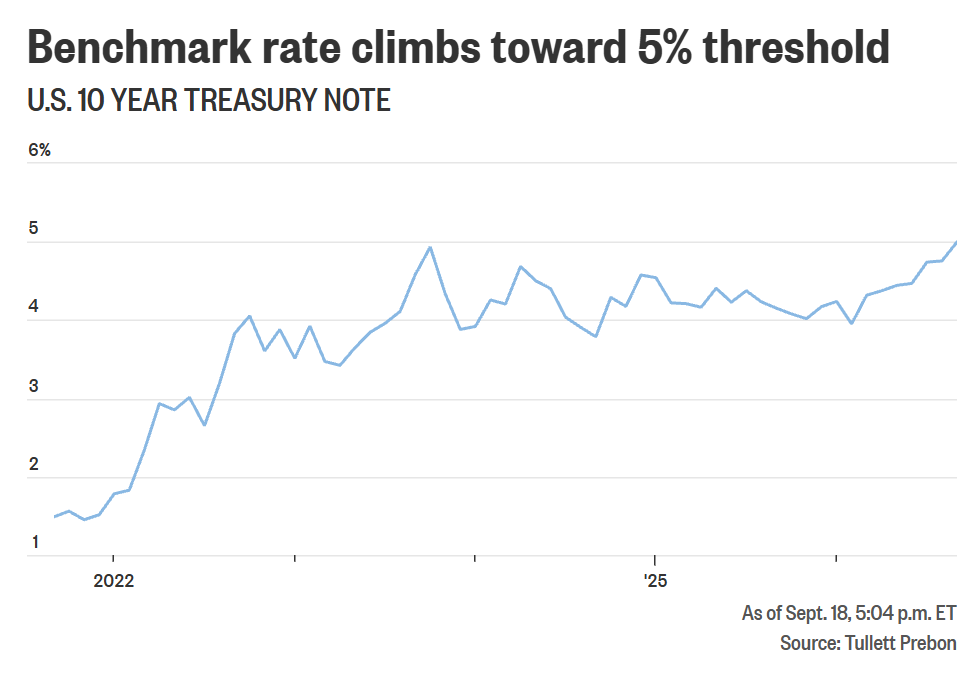
The cost of borrowing is increases for everyday things like credit cards or mortgages as the yield on the 10-Year Treasury keeps rising (Source: MarketWatch).
For everyday consumers and businesses, rising Treasury yields hit far closer to home than Wall Street trading desks. Higher bond yields directly drive up the fundamental cost of capital across the entire economy, translating directly into elevated interest rates on mortgages, corporate debt, and consumer loans. This dynamic is especially critical for major tech companies funding the massive artificial intelligence expansion, which relies heavily on corporate debt markets. Furthermore, with Brent crude oil surging past $107 per barrel and fresh wholesale inflation data surprising to the upside, market odds for an immediate Federal Reserve interest rate hike spiked to 73%. Portfolio managers warn that if the Fed hesitates to hike, long-dated yields could become volatile and disorderly.
Looking at the broader economic picture, the market’s aggressive reaction shows that underlying inflationary pressures and massive global deficit spending are currently overpowering government attempts to cap borrowing costs. As world economies compete for investment capital to finance heavy debt loads, the friction between fiscal interventions and market demand is coming to a head. Whether the Fed hikes rates at its next meeting or holds steady, the takeaway for the broader economy remains the same: high energy prices combined with unanchored government bond yields will keep borrowing costs elevated, squeezing both business investment and household spending capacity.
Subscribe for free to receive our FREE Retirement Calculator and Guide
Trump Announces Historic Greenland Security Pact to Neutralize Chinese and Russian Arctic Ambitions
President Donald Trump announced a historic security agreement with Denmark and Greenland that grants the United States permanent control over the island’s defense needs. Hailed by national security experts as a landmark geopolitical triumph on par with the 1867 purchase of Alaska, the pact secures vital North American defense geography along the northeast flank. While Denmark and Greenland emphasized that the deal preserves their territorial sovereignty through formal parliamentary approval, the agreement explicitly blocks adversary nations—specifically China and Russia—from establishing military bases or securing strategic economic investments in the region.
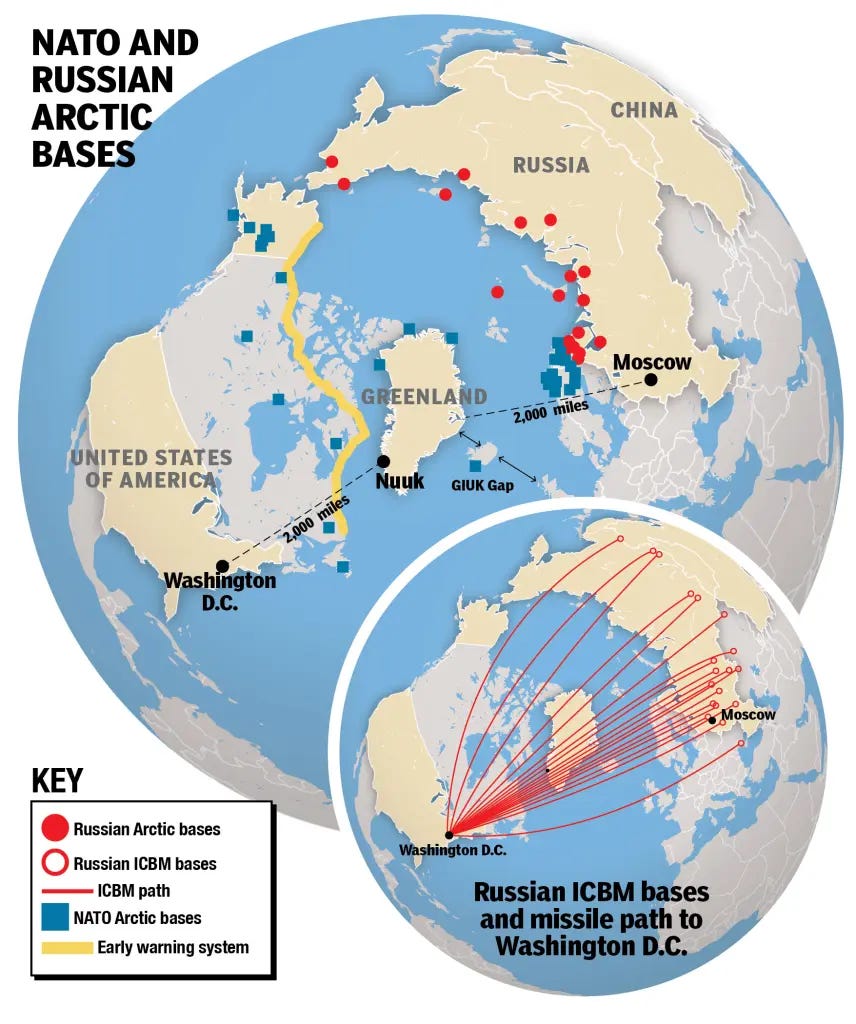
Greenland is a key part of the NATO strategy to protect their member countries from threats from China and Russia, as Greenland allows the United States to control the airspace between Moscow and the United States (Source: NY Post)
From an economic and taxpayer standpoint, the primary takeaway is a major strategic win achieved without a heavy financial burden. President Trump confirmed that the agreement guarantees U.S. defense access at zero cost to American taxpayers, locking in crucial maritime and regional security in the Arctic. Secretary of War Pete Hegseth noted that the U.S. will immediately begin developing an expanded military presence across key areas of the island. For the broader domestic economy, securing this vast northern territory eliminates a potential vector for foreign coercion, protecting vital trade corridors, resource routes, and North American airspace without straining national fiscal resources.
Looking at the geopolitical landscape, the Greenland deal reflects a broader doctrine aimed at fortifying homeland security and rolling back adversary influence across the Western Hemisphere. Coupled with recent measures targeting Chinese presence in Panama and strategic actions in Venezuela, Washington is actively boxing out foreign powers from strategic choke points. While Beijing and Moscow are expected to voice strong opposition and potentially intensify activity in their own Arctic territories, foreign policy experts stress that the deal permanently anchors Greenland within North America’s strategic defense perimeter, giving the U.S. long-term stability and tactical leverage in a rapidly changing polar region.
Subscribe for free to receive our FREE Retirement Calculator and Guide
Follow along on social media for key updates:
Instagram: TheMarketDispatch
Disclaimer:
The information provided by The Market Dispatch is for educational and informational purposes only and should not be construed as financial, legal, or investment advice.
The Market Dispatch, its authors, and contributors are not financial advisors, brokers, or attorneys. Any opinions, analyses, or projections expressed are solely those of the authors and do not constitute specific recommendations for any individual.
Investing involves risk, including the potential loss of principal and capital. Past performance does not guarantee future results. Before making any financial decisions or investments, you should consult with a qualified financial advisor or other professional who understands your personal circumstances.
By reading this newsletter or using any related materials, you acknowledge and agree that The Market Dispatch and its team will not be held liable for any loss, damage, or expense incurred as a result of reliance on the information provided.