

For more than a decade after the 2007–2009 bear market, the fixed-income side of a portfolio paid almost nothing. Rates sat near zero, government bonds offered little yield, and the working assumption on Wall Street and in many households was that stocks were the only place to earn a meaningful return. The shorthand for that mood was TINA: There Is No Alternative.
Eileen Olson, a certified financial planner and founder of Emerald Wealth in South Carolina, puts it cleanly. “TINA was never an investment strategy. It was a mood,” she says. “For more than a decade, near-zero rates pushed people into stocks because nothing else paid.”
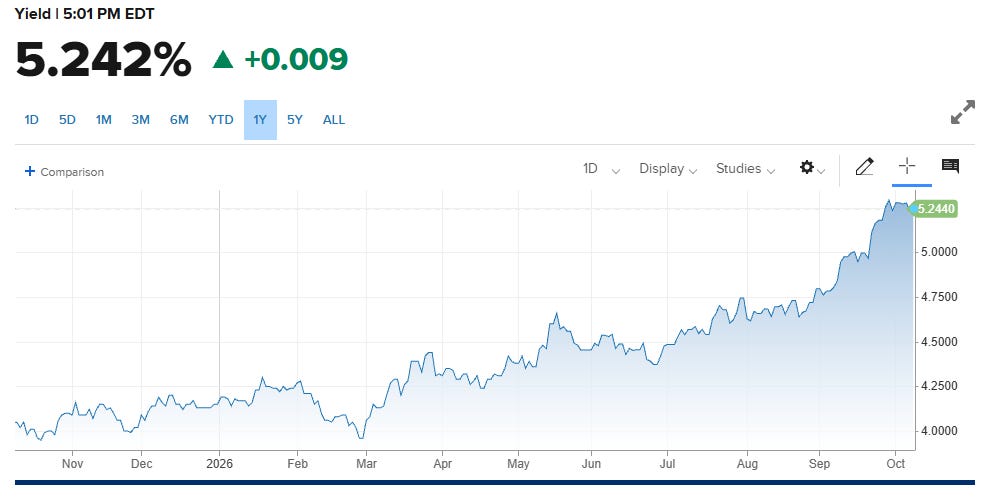
The Yield of the 10-Year Treasury bond has been rising steadily this year, making it more attractive for investors (Chart source: CNBC)
That mood is harder to sustain now. Stocks are still rising—the S&P 500 hit an all-time high on October 6—but Treasury yields have moved to levels not seen in more than two decades. On Wednesday the one-year Treasury bill yielded 4.442% and the 10-year note yielded 5.35%, the highest since April 2002. The next day the 10-year touched 5.36%. By the close of the following session it was still near 5.28%, with the 30-year at 5.67%. These are not the yields of the post-crisis decade.
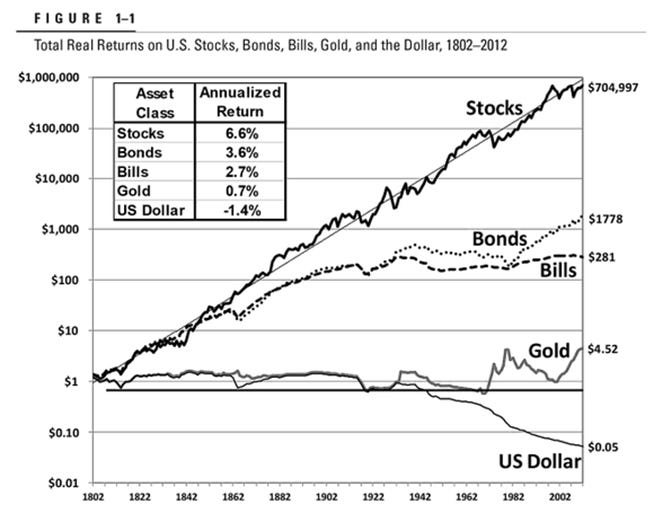
Investors have historically preferred Stocks over Bonds because they are more volatile but might lead to higher returns as well (Chart source: Verdadcap)
Olson’s concern is that many investors have not adjusted. “Because the last 15 years trained them to think stocks are the only game in town. That’s recency bias, and it’s one of the most expensive habits in investing.” Bonds have historically delivered lower average returns than stocks. They also come with lower volatility and, if held to maturity, a cash flow that is effectively certain for a government obligation. When even the lowest-risk bonds pay something competitive with what stocks have offered in the short run, the old default starts to look incomplete.
What the money is for
The first useful question is not whether stocks or bonds are better. It is what the money is supposed to do. Olson’s framing is direct: “Before asking ‘stocks or bonds?’, ask ‘what is this money for?’ Money you need for a home in two years, retirement income in five, and your grandchildren’s future in twenty shouldn’t all be invested the same way.”
