

For over eighty years, the U.S. Dollar (USD) has reigned supreme. It has been the “greenback” bedrock of global trade, the “safe haven” for central banks, and the primary currency for the world’s most vital commodities. However, as we move through early 2026, a historic shift is unfolding. The question isn’t just whether the dollar is weakening—it’s whether the very foundation of its “exorbitant privilege” is beginning to crack.
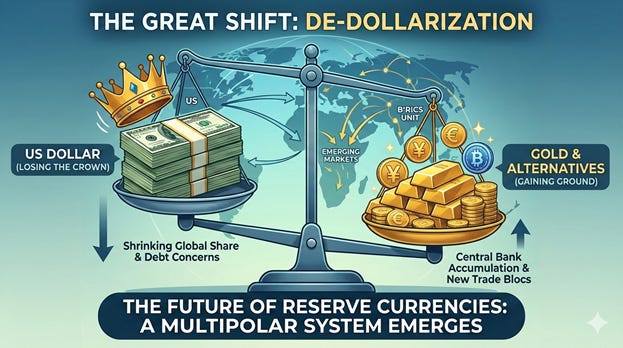
The 2026 Turning Point: Gold vs. Treasuries
The most startling headline of the year so far has been the “Gold Flip.” For the first time since 1996, the total value of gold held by foreign central banks has surpassed their holdings of U.S. Treasuries. With gold prices hovering between $4,500 and $5,500 per ounce, nations are increasingly voting with their vaults.
This shift indicates that central banks are no longer viewing U.S. debt as the ultimate risk-free asset. Instead, they are turning to “neutral” assets—hard commodities that cannot be frozen by sanctions or devalued by a ballooning U.S. deficit, which recently crossed the $38 trillion mark.
The Catalysts of De-dollarization
Several factors are converging to accelerate the search for a future of the US dollar as reserve currency that looks very different from the past:
Geopolitical Weaponization: The use of the dollar as a tool for sanctions has prompted the BRICS+ bloc (Brazil, Russia, India, China, South Africa, and new members) to build parallel payment systems. The rumored “Unit”—a gold-backed digital trade currency—is no longer a theoretical concept but a growing strategic threat to the SWIFT network.
Fiscal Stability & The Debt Ceiling: As of February 2026, the return of the U.S. debt limit has reignited political gridlock in Washington. Investors are wary of the Debt to GDP Ratio, which has reached levels that historically precede currency volatility.
Monetary Policy Uncertainty: With the Federal Reserve transitioning leadership in early 2026 and navigating a “V-shaped” economic year, the dollar has seen significant swings. Lower interest rates in the first half of the year have narrowed the yield gap, making other currencies more attractive to global investors.
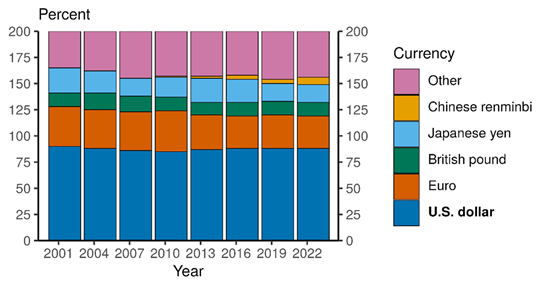
Share of over-the-counter foreign exchange transactions (Courtesy of the Federal Reserve)
The Case for Dollar Resilience
Despite the noise, the dollar isn’t going to vanish overnight. To understand the future of the US dollar as reserve currency, one must look at the alternatives.
Liquidity: The U.S. Treasury market remains the deepest and most liquid in the world.
No Clear Successor: While the Euro is stable, it faces its own structural growth issues. The Chinese Yuan (CNY) is growing but lacks the transparency and open capital markets required for a true global reserve leader.
The “Cleanest Dirty Shirt”: Even with its flaws, the U.S. economy—driven by a 2025-2026 boom in AI infrastructure and energy independence—remains more robust than most of its peers.
What This Means for Investors
The trend toward a multipolar monetary system is real and accelerating. We are moving away from a world of “Dollar Hegemony” toward one of “Currency Diversification.”
For the readers of The Market Dispatch, this suggests a long-term strategy of diversification. Increasing exposure to hard assets (gold, silver), keeping an eye on BRICS-led trade developments, and maintaining a healthy skepticism of “risk-free” government paper are the keys to navigating this transition.
The dollar may not be losing its crown today, but it is certainly sharing the throne.
Disclaimer:
The information provided by The Market Dispatch is for educational and informational purposes only and should not be construed as financial, legal, or investment advice.
The Market Dispatch, its authors, and contributors are not financial advisors, brokers, or attorneys. Any opinions, analyses, or projections expressed are solely those of the authors and do not constitute specific recommendations for any individual.
Investing involves risk, including the potential loss of principal and capital. Past performance does not guarantee future results. Before making any financial decisions or investments, you should consult with a qualified financial advisor or other professional who understands your personal circumstances.
By reading this newsletter or using any related materials, you acknowledge and agree that The Market Dispatch and its team will not be held liable for any loss, damage, or expense incurred as a result of reliance on the information provided.