

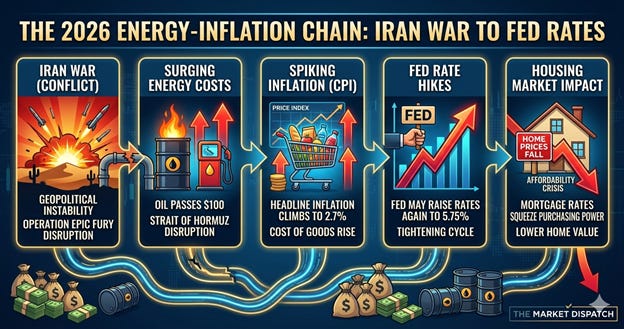
For anyone eyeing the housing market in 2026, the narrative has shifted overnight. What began as a year of “cautious optimism” for rate cuts has been derailed by the conflict in Iran. As Brent Crude remains volatile above $100, we are seeing the direct line between geopolitical war, energy inflation, and the “sticker shock” of monthly mortgage payments.
Subscribe for free to receive our FREE Retirement Calculator and Guide
The Math of Purchasing Power: Why Prices Fall When Rates Rise
There is a fundamental inverse relationship between interest rates and home prices. It isn’t just about the “cost of money”; it’s about Monthly Payment Capacity.
Most buyers don’t shop for a “price tag”—they shop for a monthly payment. When the Federal Reserve holds rates steady (or considers raising them), the 30-year fixed mortgage rate follows suit.
The Impact: For every 1% increase in mortgage rates, a buyer’s purchasing power drops by roughly 10%.
The Reality: A $2,500 monthly budget might have secured a $450,000 home last year. Today, that same budget might only cover a $400,000 home.

While buying a home has always been a key part of the American Dream, more and more people are being priced out of the housing market.
When buyers can simply afford less, sellers are eventually forced to lower their expectations to meet the market where it is. This is why high rates act as a gravity-like force, pulling home prices down (or at least keeping them flat) regardless of how much “demand” there is.
Subscribe for free to receive our FREE Retirement Calculator and Guide
The Iran War Factor: Energy Prices and the New Inflation Wave
The current situation in the Middle East has added a layer of complexity we haven’t seen in decades. Operation Epic Fury and the subsequent disruption in the Strait of Hormuz have sent energy prices skyrocketing.
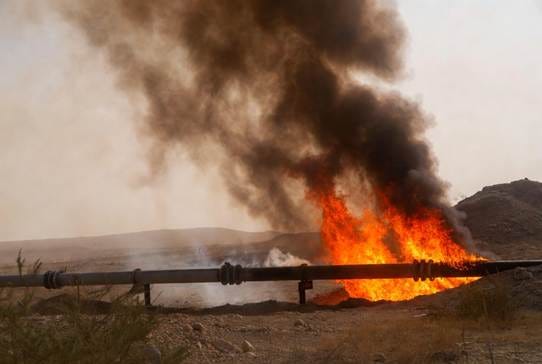
Iran’s attacks on Energy Infrastructure have led to producers cutting back, which has sent energy prices skyrocketing for the past few weeks.
For the Fed, this is a nightmare scenario. Energy isn’t just “gas at the pump”—it is the cost of shipping groceries, heating homes, and running factories. When energy prices surge, headline inflation follows.
Subscribe for free to receive our FREE Retirement Calculator and Guide
The Fed’s Dilemma: Will Rates Go Higher?
Market sentiment has shifted. Just as we expected the Fed to begin easing, the March 2026 data shows inflation sticking at 2.7%. Jerome Powell’s recent commentary suggests that if energy-led inflation doesn’t cool, the Fed may be forced to raise interest rates again to prevent a 1970s-style stagflation cycle.
For the housing market, this means the “higher for longer” era is far from over. As long as the war in Iran continues to pressure global oil supplies, the downward pressure on home prices will remain the dominant theme of 2026.
Subscribe for free to receive our FREE Retirement Calculator and Guide
Disclaimer:
The information provided by The Market Dispatch is for educational and informational purposes only and should not be construed as financial, legal, or investment advice.
The Market Dispatch, its authors, and contributors are not financial advisors, brokers, or attorneys. Any opinions, analyses, or projections expressed are solely those of the authors and do not constitute specific recommendations for any individual.
Investing involves risk, including the potential loss of principal and capital. Past performance does not guarantee future results. Before making any financial decisions or investments, you should consult with a qualified financial advisor or other professional who understands your personal circumstances.
By reading this newsletter or using any related materials, you acknowledge and agree that The Market Dispatch and its team will not be held liable for any loss, damage, or expense incurred as a result of reliance on the information provided.
While I agree that is a conundrum so to speak as to how geopolitical factors exacerbate domestic tensions via energy shortages. It’s not really an issue that rate cuts can fundamentally fix. Nor is the inflationary organic since it will cause a relative shift in consumption eventually causing demand destruction.
Infrastructure has been largely neglected for the last 30 years. Whether that's affordable starter homes or bypass oil pipelines. The solution has been banking and bombs instead of excavators and tradesmen.