

The economic data is finally catching up to reality after the government shutdown, and it’s painting a picture of two very different Americas. While the job market just hit the gas pedal and inflation is starting to chill, the average household is leaning on plastic harder than ever just to stay afloat. From a “K-shaped” economic divide at home to a looming May deadline for elections in Ukraine, we’re breaking down the four biggest stories hitting your headlines this week.
US economy added 130K jobs in January, delayed report shows
The January jobs report finally arrived after a government shutdown delay, and it brought some unexpected heat. Employers added 130,000 jobs last month—nearly double what economists predicted. With unemployment ticking down to 4.3%, the labor market is showing much more spark than many anticipated after a sluggish end to 2025.
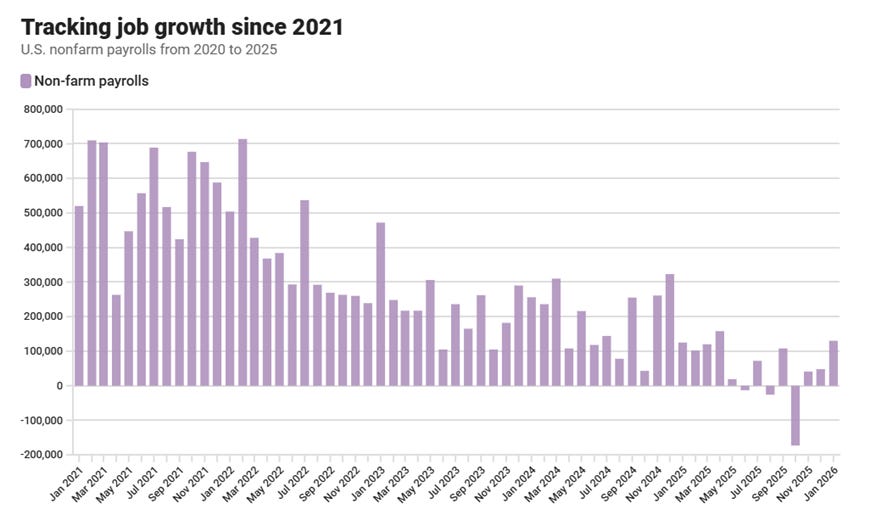
Job growth in the United States since 2021 (courtesy of Fox Business)
It wasn’t all sunshine, though. The government also released its annual “benchmarking” revisions, which painted a much bleaker picture of last year. It turns out 2025 was far weaker than initially reported, with job gains revised down by nearly 900,000. Essentially, the private sector is currently doing the heavy lifting while the federal government continues to shrink, shedding another 34,000 jobs in January alone.
Consumer prices rose 2.4% annually in January, less than expected
Finally, some good news for your grocery bill: Inflation took a breather in January. The Consumer Price Index (CPI) rose just 2.4% annually, hitting its lowest level since May 2025. This was even better than economists predicted and signals that the “nagging” inflation problem might finally be cooling off, despite the impact of recent tariffs on select goods.
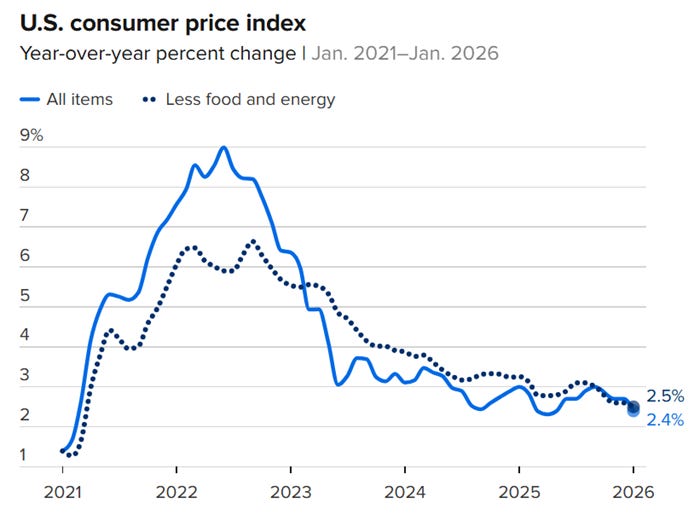
Consumer Price Index Percentage Change Year over Year (courtesy of CNBC)
What’s driving the drop? Essential costs like rent and gas are stabilizing. Shelter costs—which make up a huge chunk of your monthly budget—rose only 0.2%, while energy prices actually fell. Even though airline fares jumped, prices for groceries and used cars stayed muted, providing some much-needed relief for families feeling the squeeze of this “K-shaped” economy.
For your wallet, this means the dream of lower interest rates is officially back on the table. Following this report, markets are now betting heavily on a rate cut by June. While the Fed is staying cautious for now, the data suggests that economic growth doesn’t have to mean higher prices—offering a glimmer of hope for a “soft landing” this summer.
Zelenskyy plans major announcement on presidential election, referendum: report
President Zelenskyy is reportedly preparing a historic announcement for February 24th—the four-year anniversary of the full-scale invasion. According to the Financial Times, he is planning to call for both a presidential election and a nationwide referendum on a potential peace deal, with a target date of May 15th. This move marks a massive shift as the country continues to navigate life under martial law.

President Trump and Ukrainian President Zelenskyy meet at the White House (courtesy of Politico)
The timing isn’t a coincidence. The Trump administration is reportedly applying heavy pressure, linking future U.S. security guarantees to these votes as they aim to wrap up the war by June. While Zelenskyy publicly claimed he first heard about the specific May deadline from the press, he reiterated that he is “ready for elections”—but only if a ceasefire and international observers can guarantee a fair and safe process for both soldiers and citizens.
What’s the endgame? Recent talks in Abu Dhabi led to a successful 314-person prisoner swap, showing a rare spark of diplomacy, but a full peace deal remains a mountain to climb. Between heated territorial disputes and the logistical nightmare of voting in a war zone, Zelenskyy is walking a tightrope between domestic survival and international demands for an exit strategy.
Credit card debt tops $1.28 trillion — consistent with ‘K-shaped’ economic divide, New York Fed research shows
Americans are officially deeper in debt than ever before, with credit card balances hitting a record $1.28 trillion. While spending looks strong on the surface, researchers at the New York Fed say we’re living in a “K-shaped” economy. This means while the wealthy are doing fine and spending freely, a growing number of families are struggling just to keep the lights on.

The divide is getting harder to ignore. Delinquency rates for credit cards, auto loans, and even mortgages are climbing, particularly in lower-income areas. With the average interest rate hovering around 20%, roughly 60% of cardholders are now carrying a balance from month to month—often just to cover essential expenses like groceries and rent.
President Trump has proposed a temporary 10% cap on credit card rates to provide some relief, but don’t expect it to happen without a fight. Big banks are already gearing up for a legal battle to block price controls, arguing it would actually limit credit access for the people who need it most. For now, the financial gap is only widening, leaving millions of Americans forced to perform “financial triage” every single month.
Disclaimer:
The information provided by The Market Dispatch is for educational and informational purposes only and should not be construed as financial, legal, or investment advice.
The Market Dispatch, its authors, and contributors are not financial advisors, brokers, or attorneys. Any opinions, analyses, or projections expressed are solely those of the authors and do not constitute specific recommendations for any individual.
Investing involves risk, including the potential loss of principal and capital. Past performance does not guarantee future results. Before making any financial decisions or investments, you should consult with a qualified financial advisor or other professional who understands your personal circumstances.
By reading this newsletter or using any related materials, you acknowledge and agree that The Market Dispatch and its team will not be held liable for any loss, damage, or expense incurred as a result of reliance on the information provided.