

If you look at a brokerage account today, the world looks golden. Driven by the “AI Supercycle” and the corporate tax tailwinds of the One Big Beautiful Bill Act, the U.S. stock market has added trillions in market cap since 2024. But if you look at a bank statement for the average household, the story is far grimmer.
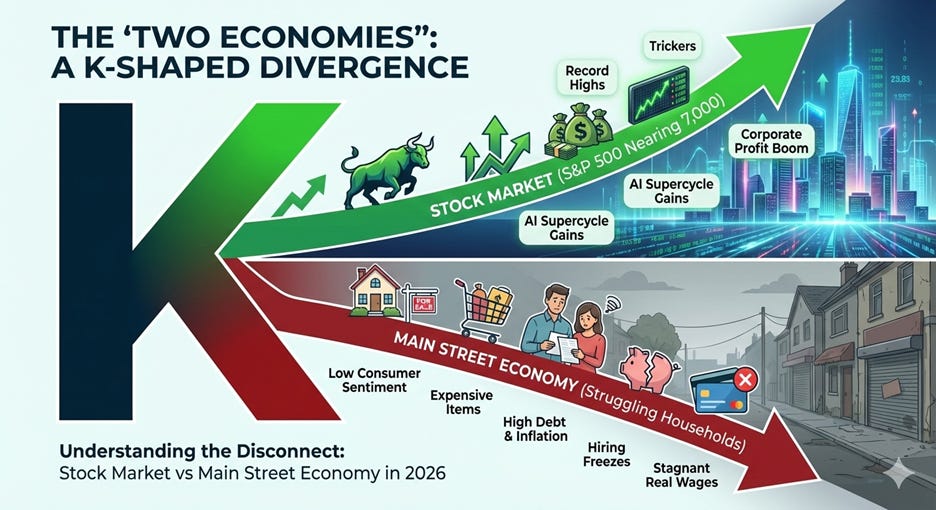
We are living in the era of the “Two Economies,” a stark divide where the stock market vs Main Street economy are no longer even speaking the same language.
1. The AI Supercycle vs. The Labor Squeeze
The primary driver of the market’s record highs is the massive capital expenditure into AI infrastructure. Companies like NVIDIA, Microsoft, and the newly ascended Broadcom are seeing double-digit earnings growth. However, this “efficiency” often comes at the cost of the Main Street workforce.
While corporate profits soar, many sectors are seeing a “hiring freeze” in non-tech roles. The market rewards this margin expansion, but for the average worker, it feels like a period of high uncertainty and stagnant wage growth.
Subscribe for free to receive our FREE Retirement Calculator and Guide
2. The Wealth Effect: A K-Shaped Reality
The “Two Economies” is best described as a K-shaped recovery.
The Upward Arm: Wealthier households, who own the majority of equities and real estate, are seeing a “wealth effect.” As asset prices rise, their spending remains robust, which further fuels corporate earnings.

Wealthier households have profited from the rise in equity prices and are fueling most of today’s consumer spending.
The Downward Arm: The bottom 60% of earners, who hold little to no stock, are facing the brunt of “sticky” inflation. Even as headline CPI moderates to around 2.7%, the cumulative price increases since 2021 have left essential costs—housing, insurance, and groceries—at levels that outpace median income growth.
3. The Debt Trap: Delinquencies at a Decade High
Perhaps the most telling statistic of 2026 is the rise in household debt. Total U.S. household debt has surged to $18.8 trillion. While the stock market celebrates the “soft landing,” the “Main Street” reality is a transition into serious delinquency for credit cards and auto loans, which have hit their highest rates since 2017.
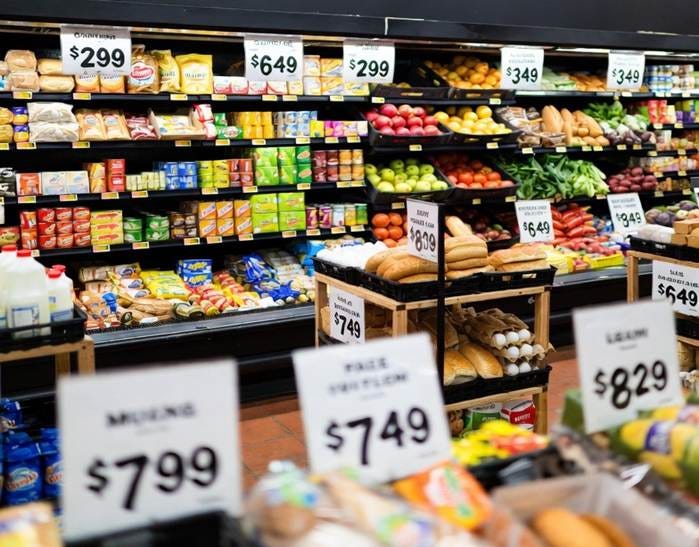
Prices of groceries have risen dramatically since the Covid-19 pandemic
For many, the Debt-To-Income ratio is no longer sustainable at current interest rates. This creates a “fragile expansion” where the top of the economy is booming on tech-led productivity, while the foundation is cracking under the weight of high borrowing costs.
4. Why the Disconnect Persists
Investors must remember that the stock market is a forward-looking indicator, while economic data like unemployment and sentiment are lagging indicators. The market is currently “pricing in” the benefits of future Fed rate cuts and the massive productivity gains promised by AI. Main Street, meanwhile, is living in the “now”—dealing with the reality of 7% mortgage rates.
What This Means for The Market Dispatch Readers
Navigating this divide requires a two-pronged strategy. While it is tempting to stay “risk-on” to capture the AI-driven market gains, one must remain wary of the consumer-led “rolling recession” that is still hitting small businesses and retail.
The “Two Economies” won’t stay separated forever. Eventually, the struggles of Main Street tend to catch up with the valuations of Wall Street. The question for 2026 isn’t if they will converge, but how painful that convergence will be.
Subscribe for free to receive our FREE Retirement Calculator and Guide
Disclaimer:
The information provided by The Market Dispatch is for educational and informational purposes only and should not be construed as financial, legal, or investment advice.
The Market Dispatch, its authors, and contributors are not financial advisors, brokers, or attorneys. Any opinions, analyses, or projections expressed are solely those of the authors and do not constitute specific recommendations for any individual.
Investing involves risk, including the potential loss of principal and capital. Past performance does not guarantee future results. Before making any financial decisions or investments, you should consult with a qualified financial advisor or other professional who understands your personal circumstances.
By reading this newsletter or using any related materials, you acknowledge and agree that The Market Dispatch and its team will not be held liable for any loss, damage, or expense incurred as a result of reliance on the information provided.
Great read, thx for sharing. I think you really identified a key pain point we are facing in the near future - labor productivity is higher than ever and while it was possible to benefit from productivity as a worker in the 70s and 80s. Today that very same economic benefit does not translate into individual wealth for the middle class but rather into margin expansion, growth outlook and shareholder returns that increase stock prices.
A great read, it makes all the difference in the world - how much of our financial activities are associated with investment assets vs depreciating consumerism.